Germany Immigration Options for Sri Lankans: 8 Pathways | Malirosa Pvt Ltd
Share
Visa & Pathways
10 min read
Germany Immigration Options for Sri Lankans in 2026: All 8 Pathways Explained
Most Sri Lankans know about one or two German visa pathways. Germany actually has eight. Choosing the wrong one costs 12 to 18 months of preparation time. This guide maps all eight with the exact German level required, processing times, and a clear decision framework for your profile.
Germany offers eight distinct legal immigration pathways to non-EU nationals. Most Sri Lankan candidates arrive at the embassy having prepared for just one. Choosing the wrong pathway costs 12 to 18 months of preparation time and, in some cases, a rejected visa application.
The Fachkrafteeinwanderungsgesetz (Skilled Immigration Act), significantly expanded in 2023 and 2024, opened Germany further than it has been in decades. (Source: Federal Ministry of Interior, BMI, 2024) The Chancenkarte launched in June 2024. Recognition partnerships lowered barriers for non-German qualifications. Processing times are now tracked and published by BAMF.
This guide covers all eight pathways: what German level you need, who each one is designed for, how long processing takes, and whether MALIROSA directly supports it. Read the comparison table first, then go deeper on the three pathways most relevant for Sri Lankan candidates in 2026.
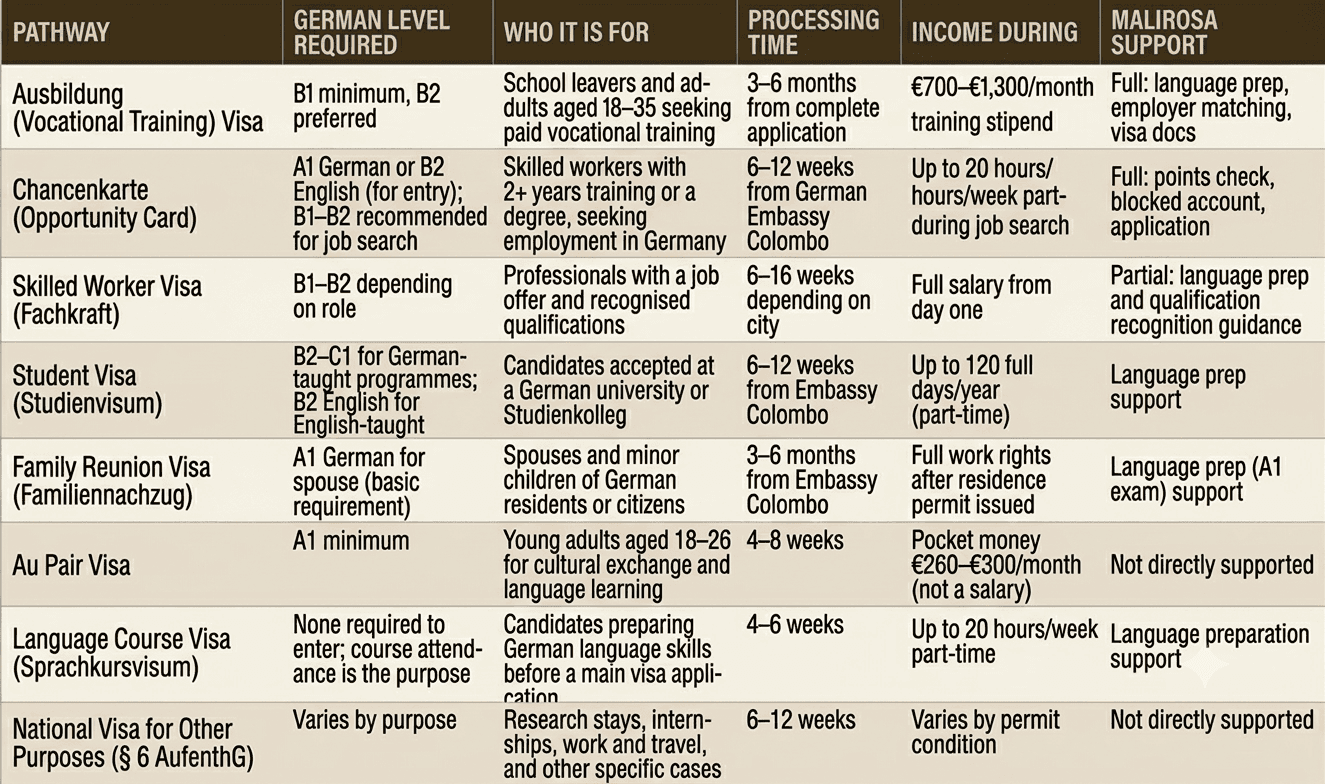
All 8 Germany Immigration Pathways: Side-by-Side Comparison
Use this table to identify which pathways apply to your profile. Processing times reflect 2026 figures from BAMF and German Embassy Colombo. "Income during" refers to what you can earn while in that status.
Pathway 1: Ausbildung: The Best Route for Most Sri Lankan Candidates
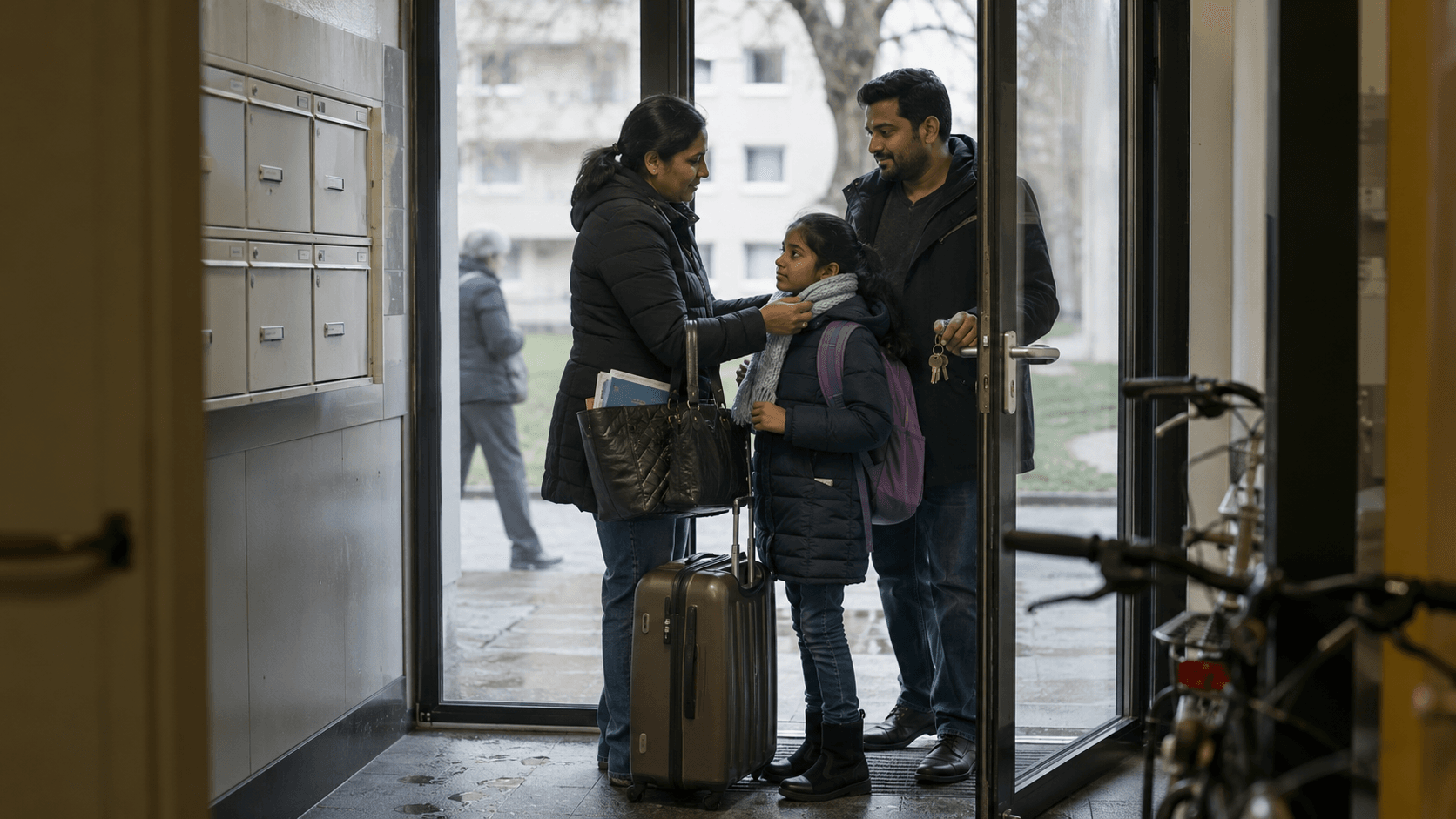
Ausbildung is Germany's dual vocational training system. You split your time between a training company and a vocational school (Berufsschule). Training lasts two to three and a half years depending on the profession. During that time, you are employed; you receive a monthly training stipend that starts at the BBiG statutory minimum of €682 in Year 1 (2026 figure) and is often significantly higher in nursing, IT, and technical trades. (Source: Federal Institute for Vocational Education and Training / BIBB, 2026)
For Sri Lankan candidates, Ausbildung works because it does not require a German degree or a prior job offer in a regulated profession. You need a training contract from a German employer, proof of B1 German (B2 is strongly recommended to compete), and the standard visa documents. The employer applies to the Federal Employment Agency (Bundesagentur fur Arbeit) for approval, which is usually granted quickly for shortage occupations.
The most in-demand Ausbildung sectors for international candidates in 2026 are nursing and elderly care, IT systems integration, logistics, gastronomy, hotel management, retail management, and industrial mechanics. After completing Ausbildung, you receive an 18-month stay permit to job-seek in Germany, and most candidates are hired directly by the company where they trained.
B1 is the visa requirement; B2 is what competitive employers expect in interviews
Training stipend ranges from €682 (statutory minimum, Year 1) to €1,300+ in top sectors
Route to permanent residency: complete Ausbildung → work 2 years → apply for settlement permit
No degree required; school leaving certificate (A/L or equivalent) is sufficient
MALIROSA supports the full process: language preparation, employer matching, visa documents
If you are between 18 and 35, have completed A/Ls or equivalent, and can commit to reaching B1 within 12 months, Ausbildung is almost always the right first pathway to evaluate.
Pathway 2: Chancenkarte: Germany's Points-Based Job-Seeker Visa
The Chancenkarte launched on 1 June 2024 under the expanded Skilled Immigration Act. It is a one-year residence permit that lets you enter Germany and search for a job without needing a contract first. This is a significant departure from Germany's previous system, which generally required employment to be secured before entry.
To qualify, you must score at least 6 out of 10 possible points across four criteria: your qualification level, professional experience, German language skills, and additional factors including age and connection to Germany. You also need basic German (A1) or English (B2), plus proof of financial self-sufficiency; a blocked account of €13,092 for 2026 covers one year.
During the Chancenkarte year, you can work up to 20 hours per week in part-time employment, and you can do trial work placements of up to two weeks each, an unlimited number of times. If you secure a qualifying job, you convert directly to a skilled worker residence permit without leaving Germany. (Source: Federal Office for Migration and Refugees (BAMF), chancenkarte.com, 2024–2025)
Minimum 6 points required; calculate yours before applying. See our dedicated Chancenkarte points guide.
Financial requirement: €13,092 blocked account for 2026 (€1,091/month)
Part-time work allowed up to 20 hours/week while job searching
Trial employment: unlimited two-week placements, which function as paid interviews
Conversion to work permit is possible in-country; you do not need to return to Sri Lanka
The Chancenkarte suits candidates who have work experience and a completed degree or vocational qualification, but who have not yet secured a German employer. It gives you time and legal status to conduct your job search on the ground in Germany.
Pathway 3: Student Visa: For Those Pursuing a German Degree
Germany has around 450 internationally accredited universities and universities of applied sciences (Fachhochschulen). Over 1,700 programmes are taught in English, making a German degree accessible without high German proficiency at entry. Tuition fees are minimal or zero at public universities; most charge a semester contribution of €150–€350.
To apply for a student visa, you need a letter of admission from a German university, proof of financial resources (blocked account with €11,904 for 2026, or equivalent), and health insurance. German-taught programmes typically require B2–C1 German. English-taught programmes require IELTS or TOEFL scores.
Students can work up to 120 full days or 240 half-days per year without additional permits. After graduation, you receive an 18-month job-seeker visa, and once employed, you can progress toward permanent residency. The student pathway is longer than Ausbildung but leads to a degree qualification that opens different employer segments.
Blocked account requirement: €11,904 for the 2026 academic year (Source: make-it-in-germany.com)
1,700+ English-taught programmes; degree accessible with IELTS 6.0–6.5
Work rights: 120 full days/year during studies
18-month graduate job-seeker visa after completion
Faster route to EU Blue Card if you secure a job paying €45,300+ gross/year after graduation
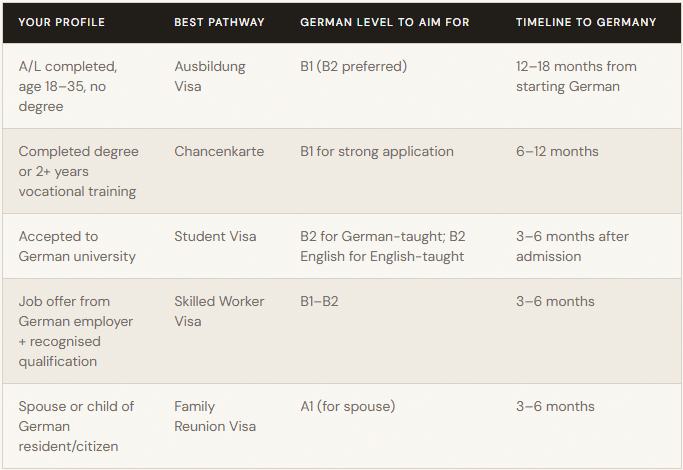
How to Choose the Right Pathway: A Decision Framework
The right pathway depends on three variables: your current qualifications, your German language level, and how quickly you need to be in Germany earning an income.
One practical rule: if your German is below A2, your priority is German language study before evaluating pathways. Every main immigration route has a language requirement. Start language classes while you clarify which pathway fits your profile.
Common Mistakes Sri Lankan Candidates Make
Understanding the pathways is only half the picture. These are the mistakes that most often delay or derail applications from Sri Lanka.
Applying for the wrong pathway. A candidate with a completed engineering degree and four years of work experience applying for Ausbildung, when they qualify for the Chancenkarte, wastes 12 to 18 months and takes a lower salary unnecessarily.
Stopping German at B1. Most visa applications require B1 as a minimum, but employers want B2. Candidates who stop at the minimum level struggle in interviews and often lose job offers to candidates from other countries who invested in B2.
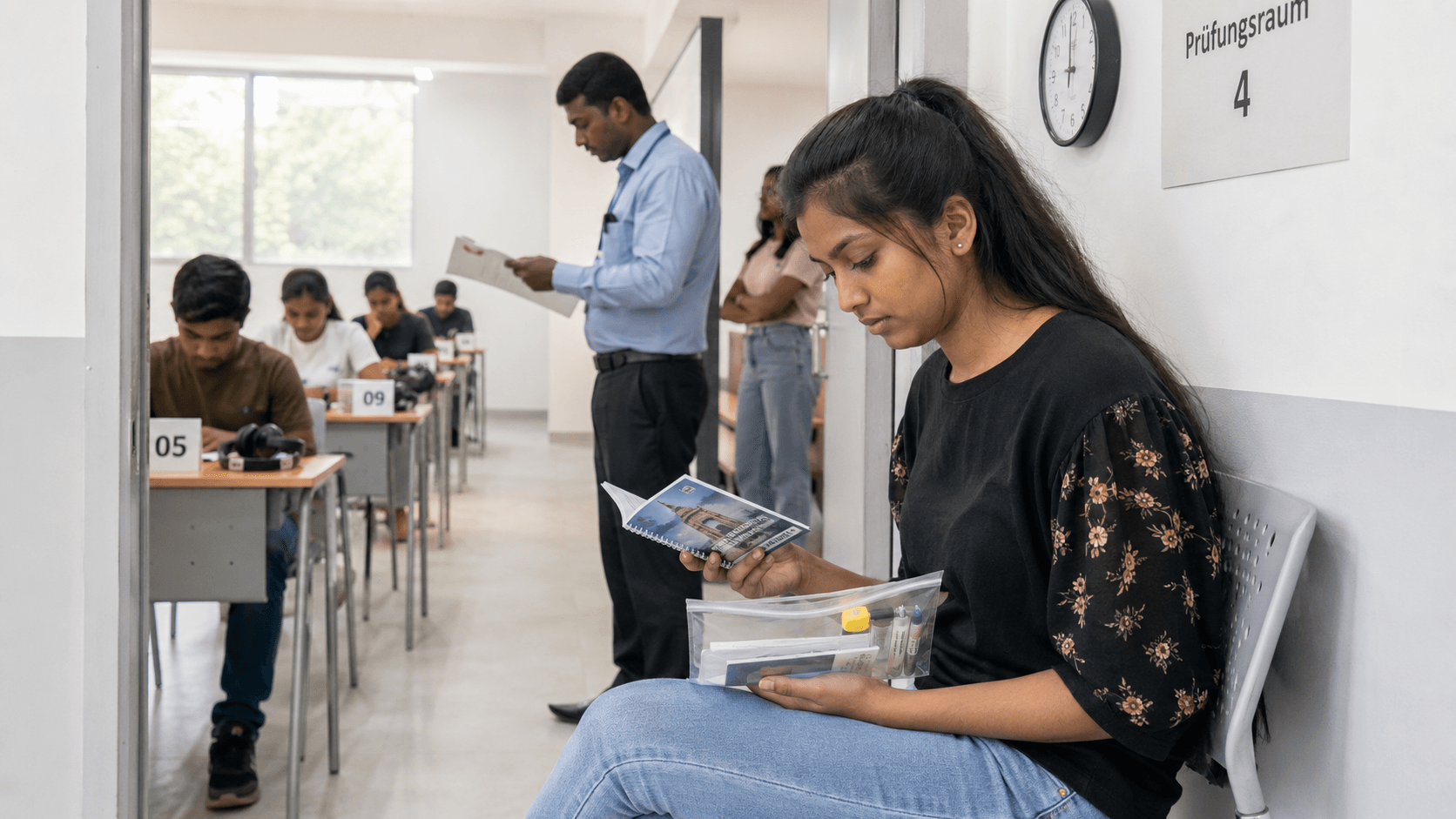
Using an unaccredited language certificate. Only Goethe-Institut, telc, and OSD certificates are widely accepted by German embassies and employers. Certificates from local language schools without international accreditation are not valid for visa purposes.
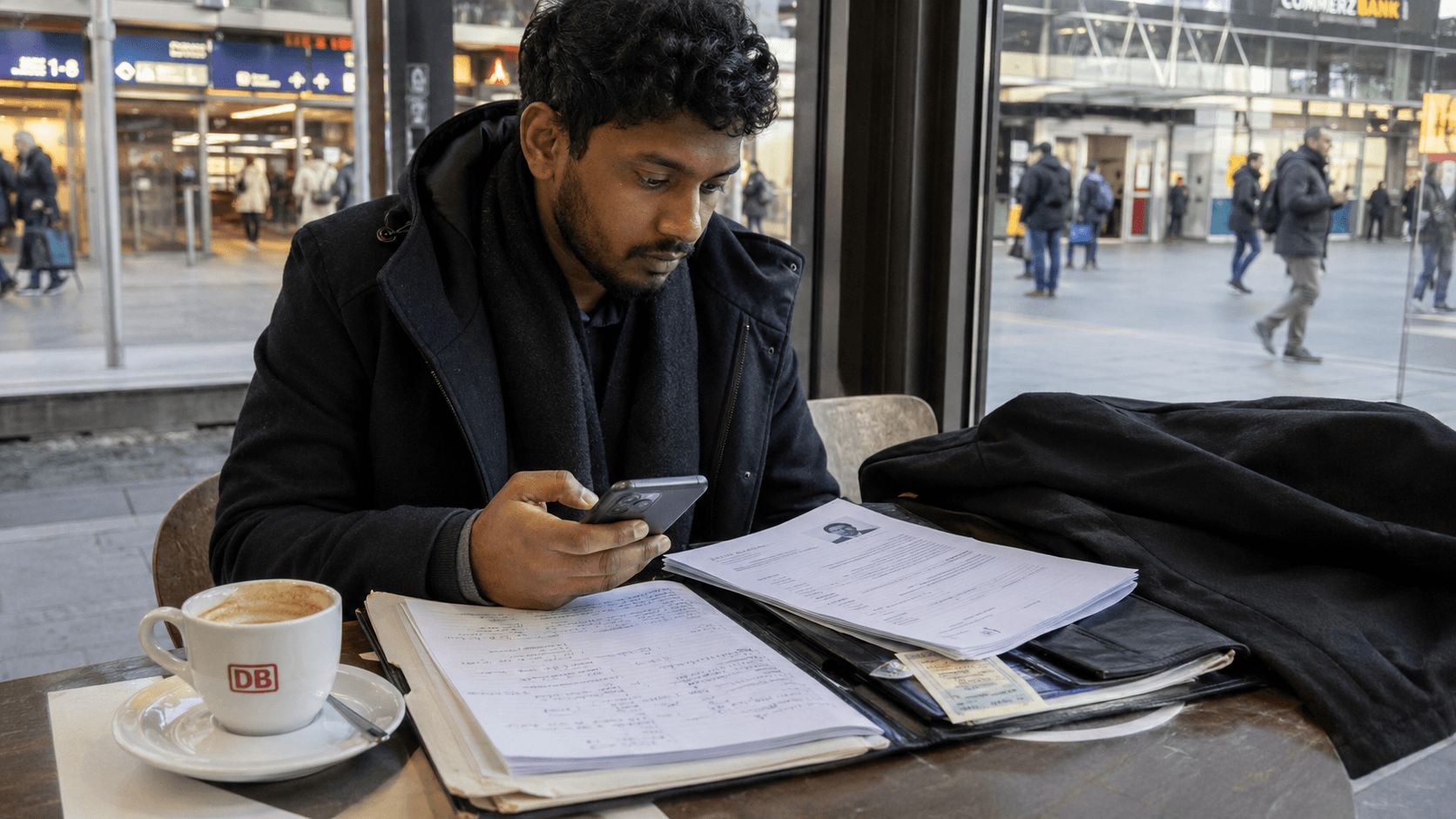
Underestimating document preparation time. Authenticated translations, police clearance certificates, and apostilled documents from Sri Lanka can take four to eight weeks to obtain. Many candidates underestimate this and miss application windows.
Not confirming qualification recognition. For the skilled worker visa and Chancenkarte, your foreign qualification may need formal recognition (Anerkennung) in Germany. The Make-it-in-Germany Anabin database lists which qualifications are recognised. Check before you invest time in a pathway that requires recognition you have not yet obtained.
Confusing the Chancenkarte with the job-seeker visa. The older job-seeker visa (Jobsuchervisum) still exists but has stricter requirements. The Chancenkarte replaced it as the practical choice for most candidates. Do not confuse the two when researching.
How MALIROSA Supports Your Pathway
MALIROSA operates across two countries, Colombo and Konstanz, Germany. That means our language preparation in Sri Lanka is directly connected to our knowledge of what German employers and embassies actually require.
We run German language courses from A1 to B2, prepare candidates for Goethe and telc exams, and support the full Ausbildung application process including employer matching, motivation letter writing, and visa document preparation. For the Chancenkarte, we run a free points eligibility check before you commit to any preparation.
Book a free consultation to get a clear picture of which pathway fits your profile, what German level you need to reach, and what the realistic timeline looks like.
MALIROSA offers a free 30-minute pathway consultation. We will review your qualifications, current German level, and timeline, then give you a specific recommendation, not a general overview.
Continue Your Journey
Get structured guidance on every Germany visa pathway.
Randima Saiger is a co-founder of MALIROSA from Sri Lanka. She brings deep personal understanding of the Sri Lankan education system, family dynamics, and candidate aspirations, bridging local knowledge with Germany-side experience.
What is the easiest Germany immigration pathway for Sri Lankans in 2026?
There is no single easiest pathway; it depends on your profile. For school leavers aged 18–35, Ausbildung is the most accessible route because it does not require a prior job offer or a degree. For candidates with work experience and a completed qualification, the Chancenkarte requires fewer credentials than the skilled worker visa. The fastest route from application to arrival is typically the student visa if you already have a university admission letter.
Do I need German to move to Germany from Sri Lanka?
For most pathways, yes. Ausbildung requires B1 minimum (employers want B2). The Chancenkarte requires A1 German or B2 English for entry, but B1–B2 is needed to get job interviews. The student visa for English-taught programmes does not require German. Family reunion requires A1 German for spouses. The language course visa allows you to enter and learn German in Germany. If your German is zero today, start with A1–A2 classes while you research pathways.
How long does it take to get a German visa from Sri Lanka in 2026?
Processing times from the German Embassy Colombo vary by visa type: Ausbildung visa typically takes 3–6 months from a complete application; Chancenkarte takes 6–12 weeks; student visa takes 6–12 weeks; family reunion takes 3–6 months. These times assume your documents are complete and correctly certified. Incomplete applications are returned and restart the clock. Appointment availability at the embassy is separate from processing time; book appointments as early as possible.
Can I bring my family to Germany on an Ausbildung visa?
Not immediately. Ausbildung visa holders cannot bring spouses during the training period in most cases, because the income requirement for spousal reunion (financial self-sufficiency for both people) is generally not met on an Ausbildung stipend. Once you complete Ausbildung and move into full employment, family reunion becomes viable. Some exceptions exist for specific circumstances; consult directly with MALIROSA or an immigration lawyer for your specific situation.
What is the Chancenkarte and who qualifies from Sri Lanka?
The Chancenkarte is a points-based job-seeker visa introduced in June 2024. It allows you to enter Germany for one year to search for employment, without needing a job offer first. To qualify, you need a minimum of 6 points from four criteria (qualification, experience, German language, age/Germany connection), plus proof of financial self-sufficiency (€13,092 blocked account for 2026). Sri Lankans with a completed degree or 2+ years of vocational training, any German language skills, and ideally under age 35 are the strongest candidates.
Is the Germany student visa worth it if I could do Ausbildung instead?
It depends on what you want from the move. Ausbildung gets you earning and working in Germany faster, and leads to permanent residency in a similar timeframe. A German degree takes 3–5 years and costs little in tuition but requires a substantial blocked account upfront. The degree opens access to employer segments and salary levels that Ausbildung does not, especially large corporations and professional services. If your long-term goal is management or technical roles in major companies, a degree is worth the longer runway. If your goal is stable, well-paid skilled work in Germany as fast as possible, Ausbildung is typically the better choice.
Get a specific pathway recommendation for your profile.
Submit your profile and a MALIROSA consultant will review your qualifications, current German level, and timeline within 48 hours. You get a specific written recommendation: which pathway fits you, what German level you need to reach, and exactly what to do next. Not a general overview. Your situation, specifically.
What German Level Do You Actually Need for Ausbildung, Work Visas, and Study in Germany?
Most people asking 'do I need German to go to Germany?' are really asking 'how much German do I need?' The answer depends entirely on your visa category. Here is the definitive breakdown.
Family Reunion Visa Germany: Who Can Apply, What Is Required, and How Long It Takes
Germany granted over 100,000 family reunion visas in 2023. Most applicants wait between three and twelve months for an appointment at the German Embassy. Understanding the requirements before you apply can cut that wait significantly.
9 min read
Our Story
Two Worlds, One Purpose: The Story Behind MALIROSA
MALIROSA grew from a decade of living the exact journey that our candidates are about to begin: between Sri Lanka and Germany, between two cultures, two languages, and two very different sets of expectations.
5 min read
Ausbildung
How to Find an Ausbildung Employer in Germany from Sri Lanka (2026 Guide)
You cannot show up in Germany and then find an Ausbildung employer. You need a signed training contract before your visa is approved. This guide covers every active portal, how to write applications German employers actually read, and the realistic timeline from first search to visa approval.
11 min read
German Language
How to Pass the German B2 Exam from Sri Lanka: Goethe B2 vs OSD B2 Compared
B2 is the gateway to university admission in Germany, most skilled worker visas, and healthcare and IT Ausbildung contracts. If you are preparing from Sri Lanka, this guide covers exactly what B2 requires, how the Goethe B2 and OSD B2 compare in Sri Lanka, exam fees, registration, and a realistic preparation timeline from B1 to pass.