Chancenkarte Points Calculator: Do You Qualify? (2026) | Malirosa Pvt Ltd
Share
Visa & Pathways
9 min read
Chancenkarte Points Calculator: Do You Qualify? (2026 Guide for Sri Lankans)
The Chancenkarte lets you enter Germany for one year to find a job without a contract first. You need 6 points out of 10. This guide scores every criterion, walks through three real Sri Lankan candidate profiles, and tells you exactly what to fix if you fall short.
Most visa systems ask: do you have a job offer? The Chancenkarte asks something different: do you have 6 points? If yes, Germany will give you a full year to find that job yourself, with no sponsor and no employer approval before you land.
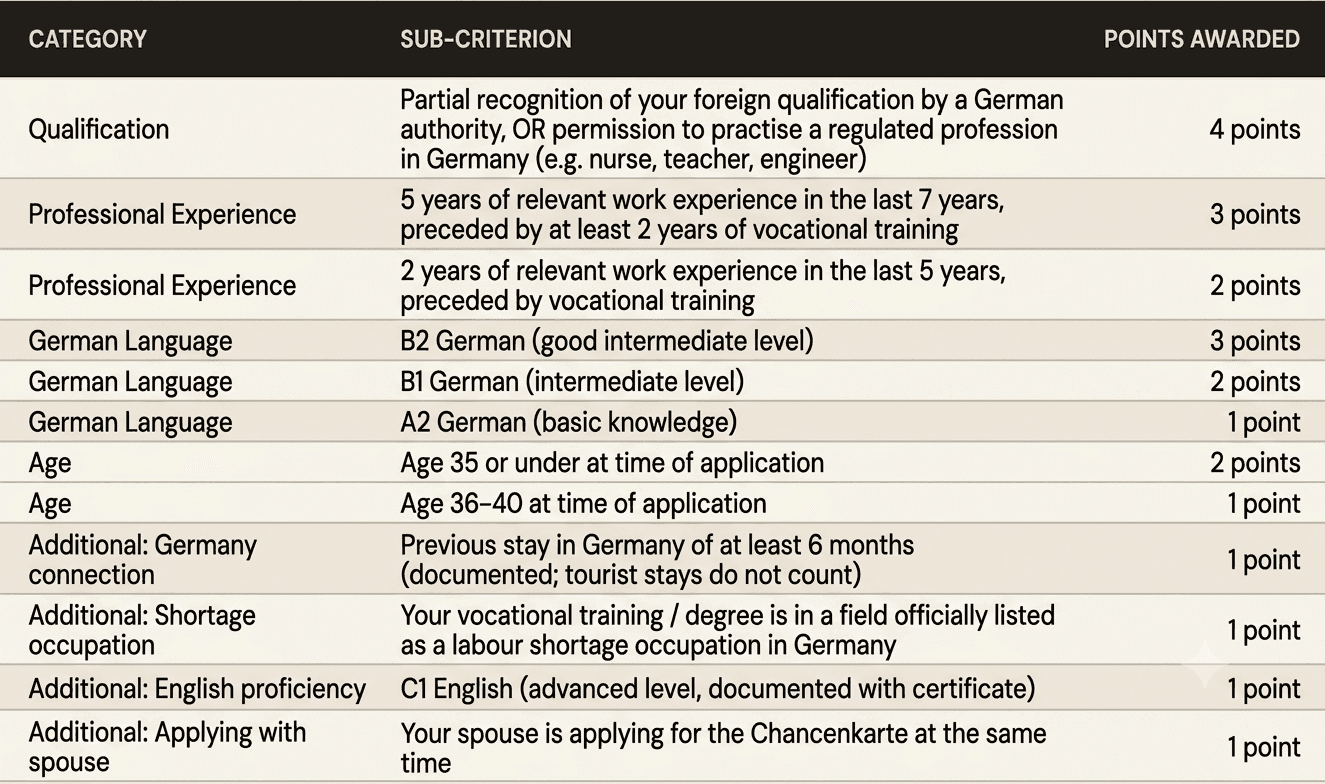
The points system covers four categories: your qualification, your professional experience, your German language level, and additional factors including age, Germany connection, and whether your field is officially in shortage. The maximum is 10 points. You need at least 6 to qualify.
This guide gives you the complete breakdown of every point allocation, drawn from the official rules published by BAMF (Federal Office for Migration and Refugees) and chancenkarte.com, plus three worked examples using profiles typical of Sri Lankan candidates. By the end, you will know your score and your next step.
Basic Requirements (No Points, But Mandatory)
Before the points system even applies, you must meet two basic requirements. These are not scored; they are pass/fail gates. If you do not meet them, you cannot apply for the Chancenkarte through the points route.
Qualification: At least two years of vocational training according to the rules of your country of origin, OR a completed university degree. The training must be state-recognised in the country where you completed it.
Language: At least A1 German OR at least B2 English. This is the minimum to enter. Most employers in Germany will require B1–B2 German for actual job interviews, but A1 or B2 English satisfies the visa requirement.
You also need to prove financial self-sufficiency for the duration of your stay. In 2026, this means a blocked account of €13,092 (€1,091/month × 12 months), OR a signed employment contract for part-time work of up to 20 hours/week before applying. (Source: chancenkarte.com, 2025)
The Chancenkarte Points System: Full Breakdown
You need a minimum of 6 points. The maximum possible score is 10. Points come from four categories. Not all combinations are possible; read each criterion carefully.
Important: Points are not additive across all categories without limit. The maximum total is 10. Points for language are separate from points for experience; you can claim both. However, the 4-point qualification criterion (partial recognition) is only available to a small number of applicants who have already initiated a formal recognition procedure. Do not count on it unless you have documentation.
Three Worked Examples: Real Sri Lankan Candidate Profiles
Abstract point tables are hard to apply to your own situation. Here are three profiles based on candidates typical of those who enquire with MALIROSA, with their calculated scores and verdict.
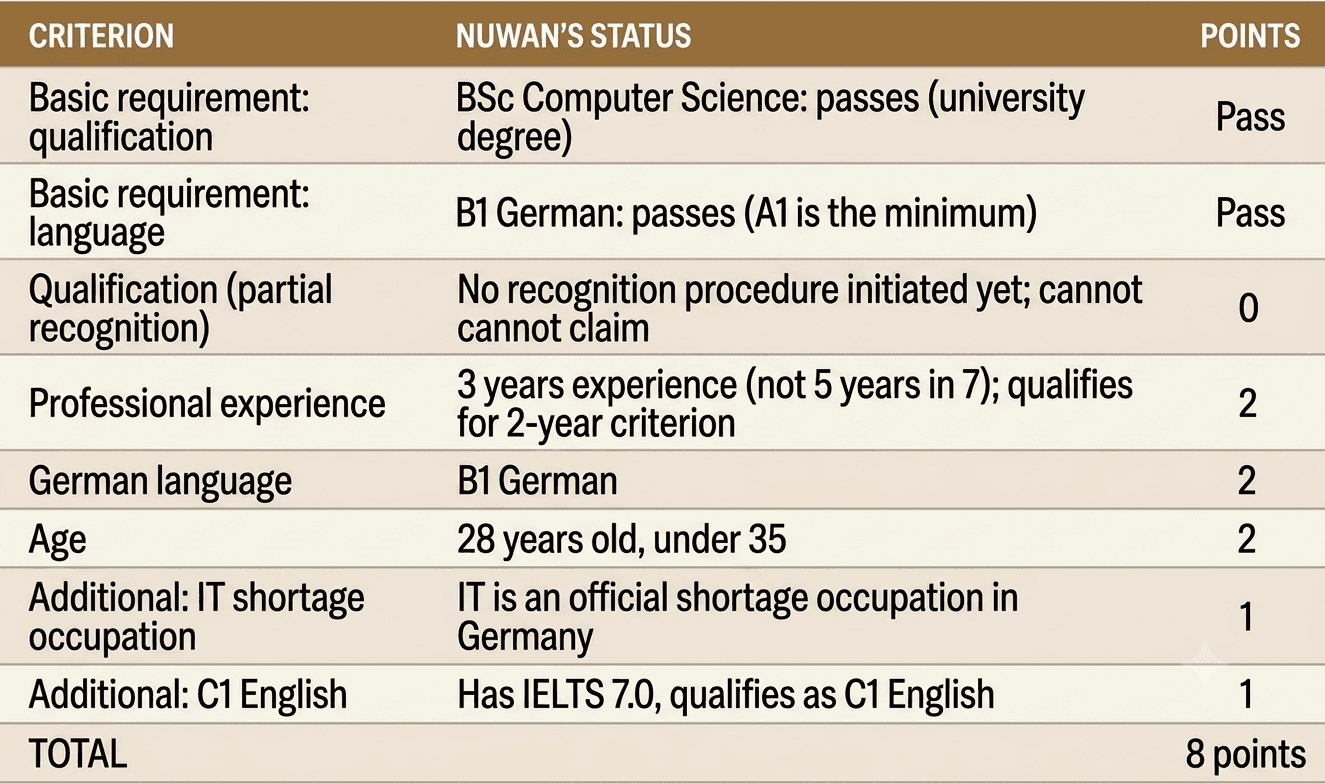
Example 1: Nuwan, 28 (IT Graduate with 3 Years Work Experience)
Nuwan completed a BSc in Computer Science at a Sri Lankan university (3 years, state-recognised). He has worked as a software developer for 3 years since graduation. His German is B1, confirmed with a Goethe-Institut certificate.
Verdict: Nuwan qualifies with 8 points, well above the 6-point minimum. He should apply for the Chancenkarte. His B1 German is adequate for the visa but he should invest in reaching B2 before arriving so he is competitive in job interviews. IT sector job-seeking in Germany is active, and his chances of finding a qualified position within 12 months are strong.
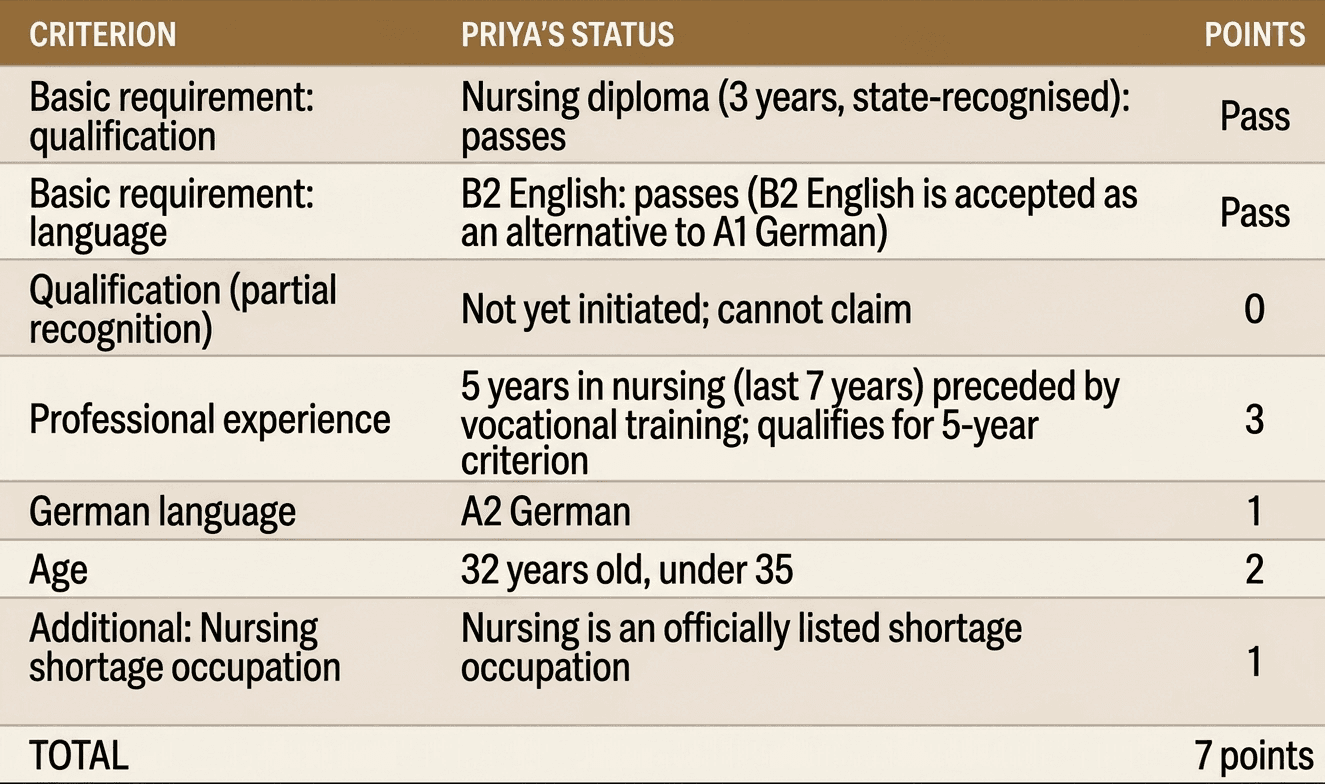
Example 2: Priya, 32 (Nurse with 5 Years Experience)
Priya completed a 3-year nursing diploma at a recognised Sri Lankan nursing college. She has worked as a registered nurse for 5 years. Her German is A2 (she has just started learning) and her English is B2.
Verdict: Priya qualifies with 7 points. However, her A2 German is a practical problem. German hospitals require a minimum of B2 German for nursing roles, and most require C1 for patient-facing positions. She should apply for the Chancenkarte now (she qualifies) but use the waiting period to aggressively build German to B2. Coming to Germany at A2 with a nursing qualification is legally permissible but practically very difficult for finding qualified work.
MALIROSA recommendation: Priya should enrol in intensive German language preparation immediately and target B2 within 12 months before applying for the Chancenkarte or the Ausbildung pathway. At B2, she can also apply directly for the skilled worker visa with a recognised nursing qualification and a job offer, bypassing the Chancenkarte entirely.
For nurses: German hospitals want B2 minimum, and the Nursing Act requires language proof before you can practise. The Chancenkarte gets you to Germany, but it does not solve the language gap. Invest in B2 first.
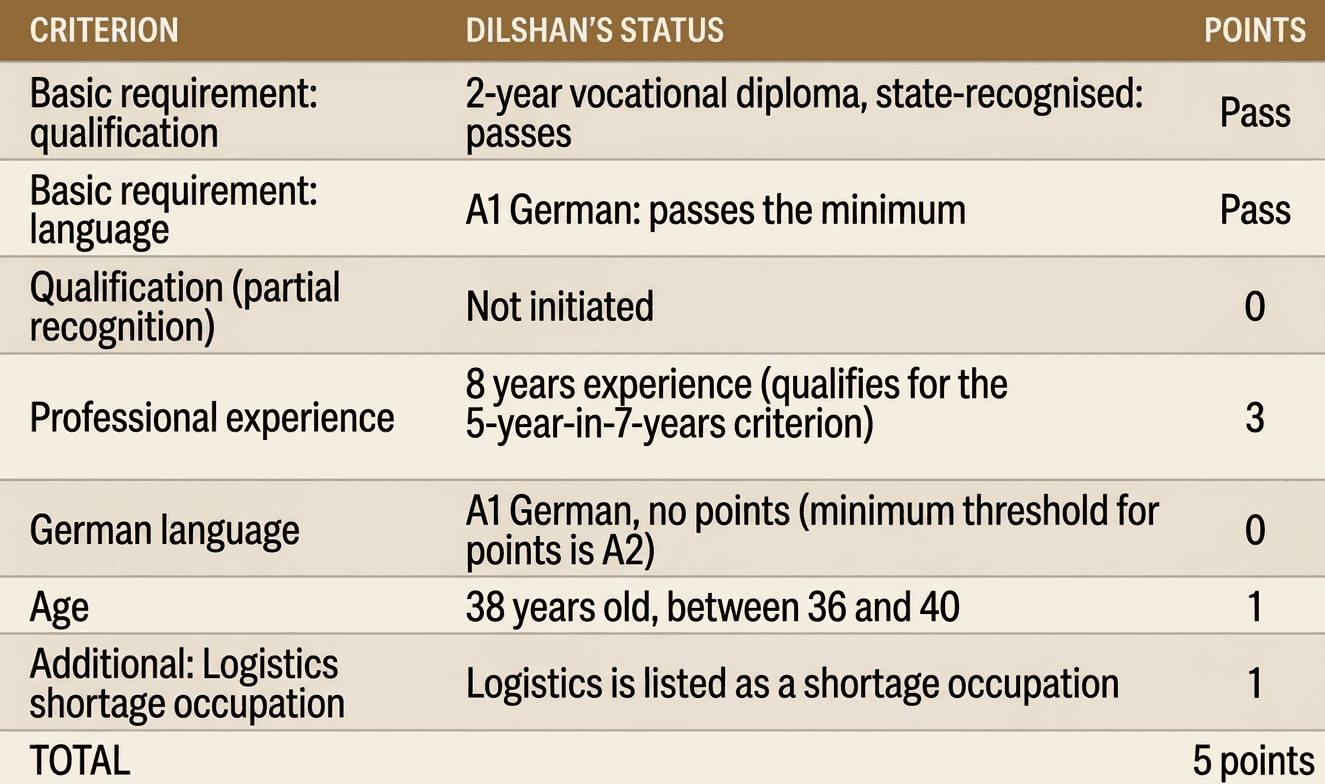
Example 3: Dilshan, 38 (Logistics Manager with 8 Years Experience)
Dilshan completed a 2-year vocational diploma in supply chain management from a Sri Lankan technical college. He has 8 years of logistics work experience. His German is A1 (just completed a beginner course). He is 38 years old.
Verdict: Dilshan does not qualify. He has 5 points, one short of the 6-point minimum. He is very close. One additional point from any of these improvements would push him over the threshold:
MALIROSA recommendation: Dilshan should enrol in German A2 classes immediately. At his age (38), he is close to the age boundary; at 40, he drops from 1 point to 0 for the age criterion. Reaching A2 in 4–6 months and applying at 38–39 gives him 6 points and qualifies him. If he can reach B1, he has 7 points and a significantly stronger job-search position in Germany.
Reach A2 German (adds 1 point); this is the fastest fix
Reach B1 German (adds 2 points and puts him at 7 total)
Obtain C1 English if he has not already documented it (adds 1 point)
Apply together with his spouse if applicable (adds 1 point)
MALIROSA recommendation: Dilshan should enrol in German A2 classes immediately. At his age (38), he is close to the age boundary; at 40, he drops from 1 point to 0 for the age criterion. Reaching A2 in 4–6 months and applying at 38–39 gives him 6 points and qualifies him. If he can reach B1, he has 7 points and a significantly stronger job-search position in Germany.
What to Do If You Do Not Have 6 Points Yet
If your current score is below 6, you are not rejected. You are not yet ready. The most common gaps and how to close them:
German language below A2: Enrol in an A1–A2 course immediately. Reaching A2 adds 1 point. Reaching B1 adds 2 points. This is the single most impactful action most candidates can take.
Experience criterion not yet met: If you have 1–2 years of experience after vocational training, you need to build to 2 years to qualify for 2 points. Plan your application timeline around this.
Age approaching 40: If you are 39, act now. At 40, the age criterion disappears. Delay costs you 1 point permanently.
No clear shortage occupation match: Check the official BIBB shortage occupation list for your profession. If your field qualifies, document it with your certificates for the application.
Consider the Ausbildung pathway instead: If you are under 35 and your German is approaching B1, Ausbildung may be a better route. You earn during training, gain a German qualification, and have a direct path to permanent residency. MALIROSA offers a free pathway comparison consultation.
How to Apply for the Chancenkarte After Confirming You Qualify
Once you have confirmed your points score and your basic requirements, the application process is straightforward. Apply at the German Embassy in Colombo.
Prepare your documents: passport, qualification certificates (original + certified translation), employment references documenting work history, language certificate, proof of financial self-sufficiency (blocked account statement or employment contract), and biometric photographs.
Book an appointment at the German Embassy Colombo. Appointment slots are limited; book as early as possible. As of 2026, typical waiting times for visa appointments in Colombo are 4–8 weeks.
Submit your application with the completed application form (available on the Embassy website), the €75 visa fee, and all supporting documents as originals plus two copies.
Wait for processing. The Chancenkarte typically takes 6–12 weeks from the date of a complete application at Embassy Colombo.
On arrival in Germany, register at the local Einwohnermeldeamt (residents' registration office) within 14 days. This is a legal requirement.
Start your job search. Use platforms like StepStone, Indeed.de, LinkedIn, and Make it in Germany's job board. Attend trial placements (Probearbeiten) to get your foot in the door with employers.
German B1–B2 is not a Chancenkarte requirement, but it is a practical job-search requirement. Candidates who arrive at B2 have dramatically higher success rates in interviews than those who arrive at A1 or A2. Do not skip this step.
Continue Your Journey
Get structured guidance on every Germany visa pathway.
Randima Saiger is a co-founder of MALIROSA from Sri Lanka. She brings deep personal understanding of the Sri Lankan education system, family dynamics, and candidate aspirations, bridging local knowledge with Germany-side experience.
You need a minimum of 6 points out of a possible 10. Points come from four areas: your qualification recognition (0 or 4 points), professional experience (0, 2, or 3 points), German language level (0, 1, 2, or 3 points), and additional criteria including age, Germany connection, shortage occupation, English proficiency, and applying with a spouse (up to 1 point each). You must also meet the basic requirements: a completed 2-year vocational qualification or university degree, plus A1 German or B2 English.
Does the Chancenkarte require a job offer?
No. That is the defining feature of the Chancenkarte. You enter Germany without a job offer and spend up to 12 months searching for qualified employment. During that time, you can work part-time up to 20 hours per week and do trial placements of up to two weeks each. Once you secure a qualifying job, you convert to a standard work permit without leaving Germany.
How much money do I need in my bank account for the Chancenkarte?
€13,092 is the standard blocked account (Sperrkonto) requirement for a full 12-month Chancenkarte stay in 2026 (€1,091 per month). (Source: chancenkarte.com / BAMF, 2025). This is the most common way to prove financial self-sufficiency. Alternatively, you can show a signed employment contract for part-time work (up to 20 hours/week) concluded before applying. The blocked account must be held at a bank that restricts monthly withdrawals to the permitted amount.
Can a Sri Lankan nurse apply for the Chancenkarte?
Yes, if they have a recognised nursing qualification (2+ years, state-recognised) and meet the basic language requirement (A1 German or B2 English). However, German hospitals require B2 German minimum for nursing practice, with most requiring C1 for patient-facing roles. Coming to Germany on the Chancenkarte at A2 German as a nurse is legally possible but practically very difficult for finding qualified nursing employment. Build to B2 first, or apply for the skilled worker visa directly once you have a job offer.
How long does Chancenkarte processing take from Sri Lanka?
From the German Embassy Colombo, typical processing time after a complete application is 6–12 weeks. This does not include the waiting time to get an appointment; book your Embassy appointment as early as possible, as slots in Colombo are limited. Total time from beginning document preparation to landing in Germany is typically 4–6 months for a well-prepared applicant.
What happens if I do not find a job during the 12 months of the Chancenkarte?
If you have not secured qualifying employment within 12 months, you are required to leave Germany. There is no automatic entitlement to an extension. However, under certain circumstances, an extension of up to two additional years is possible. Apply at your local Ausländerbehörde before the 12-month period expires. If you do find a job, you convert to a standard employment residence permit without needing to return to Sri Lanka.
Find out your exact Chancenkarte score in one call.
MALIROSA runs a free Chancenkarte points check. We review your qualifications, work experience, language certificate, and age, then give you your exact score, tell you whether you qualify, and outline your fastest path to 6 points if you are not there yet. No obligation, no vague overview.
Germany Immigration Options for Sri Lankans in 2026: All 8 Pathways Explained
Most Sri Lankans know about one or two German visa pathways. Germany actually has eight. Choosing the wrong one costs 12 to 18 months of preparation time. This guide maps all eight with the exact German level required, processing times, and a clear decision framework for your profile.
What German Level Do You Actually Need for Ausbildung, Work Visas, and Study in Germany?
Most people asking 'do I need German to go to Germany?' are really asking 'how much German do I need?' The answer depends entirely on your visa category. Here is the definitive breakdown.
7 min read
German Language
Goethe Exam Sri Lanka 2026: Dates, Fees and How to Register
The Goethe-Zertifikat is written into Germany's immigration law by name for family reunion visas. It is accepted for every other visa category too. This guide covers the 2026 fees in LKR, how to register at Goethe-Institut Colombo, what the exam actually tests, and the honest preparation timeline for A1 to B2.
9 min read
Our Story
Two Worlds, One Purpose: The Story Behind MALIROSA
MALIROSA grew from a decade of living the exact journey that our candidates are about to begin: between Sri Lanka and Germany, between two cultures, two languages, and two very different sets of expectations.
5 min read
Ausbildung
How to Find an Ausbildung Employer in Germany from Sri Lanka (2026 Guide)
You cannot show up in Germany and then find an Ausbildung employer. You need a signed training contract before your visa is approved. This guide covers every active portal, how to write applications German employers actually read, and the realistic timeline from first search to visa approval.