Ausbildung Salary Germany 2026: Real Figures by Sector | Malirosa Pvt Ltd
Share
Ausbildung
8 min read
Ausbildung Salary in Germany 2026: What You Actually Earn by Sector
Germany pays you from your first day of Ausbildung training. The statutory minimum in 2026 is €682 per month in Year 1. In nursing and IT it is closer to €1,100. This guide breaks down real salary figures by sector, what taxes come out, and whether the numbers actually cover life in Germany.
Germany pays you from your first day of Ausbildung training. Not after you qualify. Not after a probationary period. From day one. The national minimum training wage for Year 1 in 2026 is €682 per month. In healthcare, IT, and logistics, most employers pay €900 to €1,100. (Source: BIBB, Federal Institute for Vocational Education and Training, 2025)
These are not vague estimates. They are published figures from BIBB and from collective bargaining agreements across Germany's major sectors. Knowing them before you choose your Ausbildung field, and before you commit 12 to 18 months to language preparation, is basic financial planning.
This guide covers the statutory minimum by training year, sector-by-sector averages, what drives the differences, and a worked monthly budget so you can see whether the numbers actually cover life in Germany.
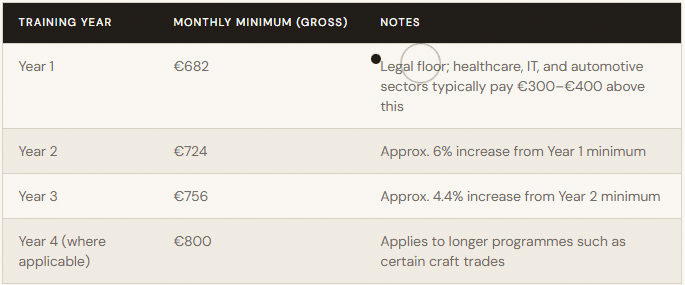
Statutory Minimum Ausbildung Salary by Training Year (2026)
The BBiG statutory minimum applies to all Ausbildung training contracts in Germany. These are the legal floors; no employer can pay below these rates. Many employers, particularly in larger companies and union-covered sectors, pay significantly above these figures.
The minimum increases each year of training to reflect growing skill and responsibility.
Source: Berufsbildungsgesetz (BBiG) Section 17, as updated in 2020 with annual indexation. The 2026 statutory minimums are indexed to Germany's general training remuneration trends published by BIBB. (Source: Bundesagentur fur Arbeit salary data, 2024)
Ausbildung Salary by Sector: What You Can Actually Expect
Sector matters far more than the statutory minimum for your actual income. Companies in nursing, IT, and automotive typically operate under collective bargaining agreements (Tarifverträge) that set salaries well above the BBiG floor. Hospitality and retail are closer to the minimum.
The figures below represent average monthly gross stipends across Germany. Regional differences exist: Bavaria and Baden-Württemberg tend to pay 5–10% above the national average; eastern German states tend to pay slightly below.
After Year 3 completion, salaries change dramatically. A qualified nurse earns €2,500–€3,200 gross/month. A Fachinformatiker in IT support earns €2,800–€3,500. An automotive mechatronics technician earns €2,400–€3,000. The training years are an investment, not a permanent salary level.
What Affects Your Ausbildung Salary
Four factors drive the difference between the statutory floor and the higher sector averages.
Sector and profession. This is the biggest driver. IT and healthcare pay significantly more than retail and hospitality because demand is higher and skills transfer is more valuable. Choose your sector with salary in mind, not just language or entry ease.
Company size and type. Large companies like Bosch, Siemens, Deutsche Telekom, and hospital networks typically pay 20 to 30 percent above the sector average because they operate under national collective bargaining agreements. Small and medium-sized enterprises often pay closer to the floor.
German state (Bundesland). Training contracts in Bavaria, Baden-Wurttemberg, and Hamburg consistently show higher average stipends than those in Saxony or Brandenburg. The cost of living also differs significantly, so the purchasing power of a €900 stipend varies by city.
Union tariffs (Tarifvertrage). If your employer is party to a collective bargaining agreement, you are covered by the tariff rates, which are always higher than the BBiG minimum. Ask about Tarifbindung when evaluating employer offers.
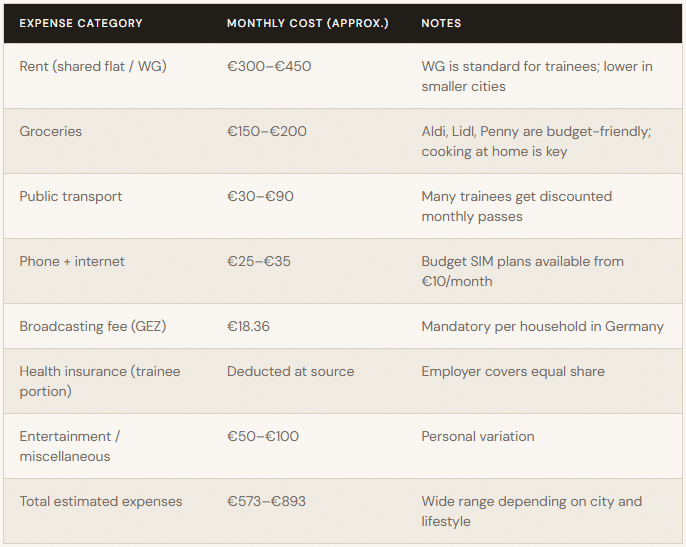
Cost of Living vs Ausbildung Salary: A Realistic Monthly Budget
Can you support yourself on an Ausbildung salary? The honest answer is yes, in most cities, with careful budgeting, especially in shared accommodation. The numbers below reflect a typical trainee budget in a mid-sized German city (not Munich or Hamburg, where rent is 40–60% higher).
The figures use a Year 1 gross stipend of €950, representative of a trainee in logistics, hospitality, or automotive. After deductions for health insurance (~7.3%), pension (~9.3%), and unemployment insurance (~1.2%), net take-home on €950 gross is approximately €820–€840.
On a €840 net income (€950 gross), a careful trainee in a shared flat in a mid-sized city has €0–€250 remaining after expenses. This is not comfortable, but it is manageable. In nursing or IT (Year 1 gross of €1,040–€1,050), net income rises to approximately €900–€920, leaving €50–€350 monthly surplus.
The picture improves in Years 2 and 3 as stipends increase. By Year 3, a nursing or IT trainee earning €1,200–€1,300 gross takes home approximately €1,040–€1,120 net, a meaningful improvement in monthly surplus.
Munich, Frankfurt, and Hamburg are more expensive. A WG room in Munich averages €700–€900. In those cities, the numbers are tighter unless your employer provides housing support, which some hospital networks and hotel groups do for trainees.
Do not rely on sending significant money home to Sri Lanka during your Ausbildung years. The stipend covers German living costs. Financial support for family in Sri Lanka should come from post-Ausbildung employment salaries.
What You Earn After Ausbildung Completes
The training salary is not the destination. It is the price of entry to a permanent, well-paying career in Germany. The salary jump from Ausbildung stipend to qualified employee salary is substantial and typically happens within 6 months of passing your final exams.
A certified nurse (Pflegefachkraft) after completing Ausbildung earns EUR 2,800–3,400 gross per month in most German states. (Source: Bundesagentur für Arbeit salary data, 2024)
After completing Ausbildung and passing to skilled worker status under §18a AufenthG, the path to earnings comparable to German graduates typically takes 3–5 years rather than the 10+ years often assumed. (Source: IW Köln earnings trajectory research, 2023)
Continue Your Journey
Full Ausbildung preparation from language to visa.
Randima Saiger is a co-founder of MALIROSA from Sri Lanka. She brings deep personal understanding of the Sri Lankan education system, family dynamics, and candidate aspirations, bridging local knowledge with Germany-side experience.
What is the minimum Ausbildung salary in Germany in 2026?
The statutory minimum under §17 BBiG is €682 per month gross in Year 1 of training (2026). This increases to €724 in Year 2, €756 in Year 3, and €800 in Year 4 where applicable. These are legal floors; no employer can pay below them. Most employers in healthcare, IT, automotive, and logistics pay significantly above these minimums under collective bargaining agreements.
Which Ausbildung sector pays the most in Germany?
IT and healthcare consistently pay the highest Ausbildung stipends in Germany. IT (Fachinformatiker) averages €1,050 in Year 1 and €1,300 in Year 3. Nursing and healthcare average €1,040 in Year 1 and €1,200 in Year 3 under the TVöD public sector tariff. Logistics and automotive follow with Year 1 averages of €900–€950.
Can I support myself on an Ausbildung salary in Germany?
Yes, in most cities, with shared accommodation and careful budgeting. On a Year 1 gross stipend of €950, your net take-home is approximately €820–€840. Monthly expenses in a mid-sized German city (shared flat, groceries, transport) run €600–€800, leaving €20–€250 surplus. Nursing and IT trainees starting at €1,040+ have more breathing room. Munich and Hamburg are significantly more expensive; budget accordingly or seek employer housing support.
How much tax do Ausbildung trainees pay in Germany?
Social security deductions (health insurance ~7.3%, pension ~9.3%, unemployment ~1.2%) total roughly 17–18% of gross income. For most Ausbildung stipends under €1,000/month, income tax is minimal or zero because the income falls below the basic personal allowance. On a €950 gross stipend, expect approximately €110–€130 in total deductions, resulting in net take-home of €820–€840.
Does Ausbildung salary increase each year?
Yes. The BBiG statutory minimum increases in each year of training. Collective bargaining agreements also typically index salaries to annual increases. In practice, a nursing trainee might earn €1,040 in Year 1, €1,100 in Year 2, and €1,200 in Year 3. After completing training and passing exams, qualified professionals can expect a salary jump to €2,500–€3,500/month depending on the sector.
Is the Ausbildung salary enough to send money home to Sri Lanka?
During Ausbildung training years, the stipend is designed to cover German living costs. It is generally not enough to send regular meaningful remittances to Sri Lanka without financial strain. Once you complete Ausbildung and move into full employment at €2,500–€3,500/month, the picture changes significantly. Plan the Ausbildung years as an investment period, not an income-generating phase for family support.
MALIROSA's placement programme matches Sri Lankan candidates with verified German employers in nursing, IT, logistics, and hospitality. We prepare your German language skills, translate your documents, and submit applications to employers who are actively hiring internationally. Apply now and we review your profile within 48 hours.
5 In-Demand Ausbildung Sectors in Germany for International Candidates (2026)
Germany's Ausbildung system has over 325 recognised training occupations. Not all of them are equally accessible for international candidates. These five sectors have the highest demand and the clearest pathways for motivated learners from Sri Lanka and abroad.
How to Apply for an Ausbildung Visa from Sri Lanka (2026 Step-by-Step Guide)
Most Sri Lankan Ausbildung visa applications are rejected not because candidates lack a training contract, but because their documents are incomplete or incorrectly certified. This step-by-step guide shows you exactly what the German Embassy in Colombo requires and how to avoid the errors that delay most applications by six months.
12 min read
German Language
What German Language Level Do You Need for Ausbildung in Germany?
The German language requirement is the single biggest factor that determines whether a Sri Lankan candidate can pursue Ausbildung in Germany. Here is exactly what level you need, why it matters, and how long it takes to get there.
10 min read
Our Story
Two Worlds, One Purpose: The Story Behind MALIROSA
MALIROSA grew from a decade of living the exact journey that our candidates are about to begin: between Sri Lanka and Germany, between two cultures, two languages, and two very different sets of expectations.
5 min read
Visa & Pathways
Family Reunion Visa Germany: Who Can Apply, What Is Required, and How Long It Takes
Germany granted over 100,000 family reunion visas in 2023. Most applicants wait between three and twelve months for an appointment at the German Embassy. Understanding the requirements before you apply can cut that wait significantly.