Healthcare Ausbildung in Germany: Elderly Care, Medical Tech and Therapy Training
One in four Germans is over 60. Germany has over 200,000 unfilled healthcare positions and no domestic pipeline to fill them. Healthcare Ausbildung pays €800-1,200/month during training across five regulated tracks. This guide covers every sector, salary figures, language requirements, and how Sri Lankan candidates get placed.
One in four Germans is over 60 years old, and that share rises every year. (Destatis, 2024) Germany has more than 200,000 unfilled healthcare positions with no domestic pipeline to close the gap. For Sri Lankan candidates with caregiving experience, a science background, or simply the right language certificate, this structural shortage has created one of the most accessible legal pathways into Germany.
Healthcare Ausbildung is a state-regulated, employer-paid training programme. You sign a contract with a German employer, receive a monthly salary from day one, and split your time between the workplace and the vocational school. No tuition fees. No unpaid placement.
This guide covers the five main healthcare Ausbildung tracks, exact salary figures by year, German language requirements per role, where employers actively recruit international candidates, and how MALIROSA supports Sri Lankan applicants through placement and document preparation.
What Is Healthcare Ausbildung in Germany?
Healthcare Ausbildung is a dual vocational training programme regulated under the Berufsbildungsgesetz (BBiG) and, for nursing and care professions, the Pflegeberufegesetz (PflBG). You train as an employee at a German healthcare institution. The employer pays your salary while you train.
The training typically runs for three years. One to two days per week you attend the Berufsschule for theoretical instruction. The remaining days you work in the hospital, clinic, laboratory, or care facility. You are supervised, assessed, and supported throughout.
International candidates are actively recruited because Germany cannot fill these positions from its domestic graduate pool. The Bundesagentur fur Arbeit runs dedicated international recruitment programmes including the Triple Win initiative, which targets nursing and elderly care candidates from non-EU countries. (Bundesagentur fur Arbeit, 2024)
The 5 Healthcare Ausbildung Tracks in Germany
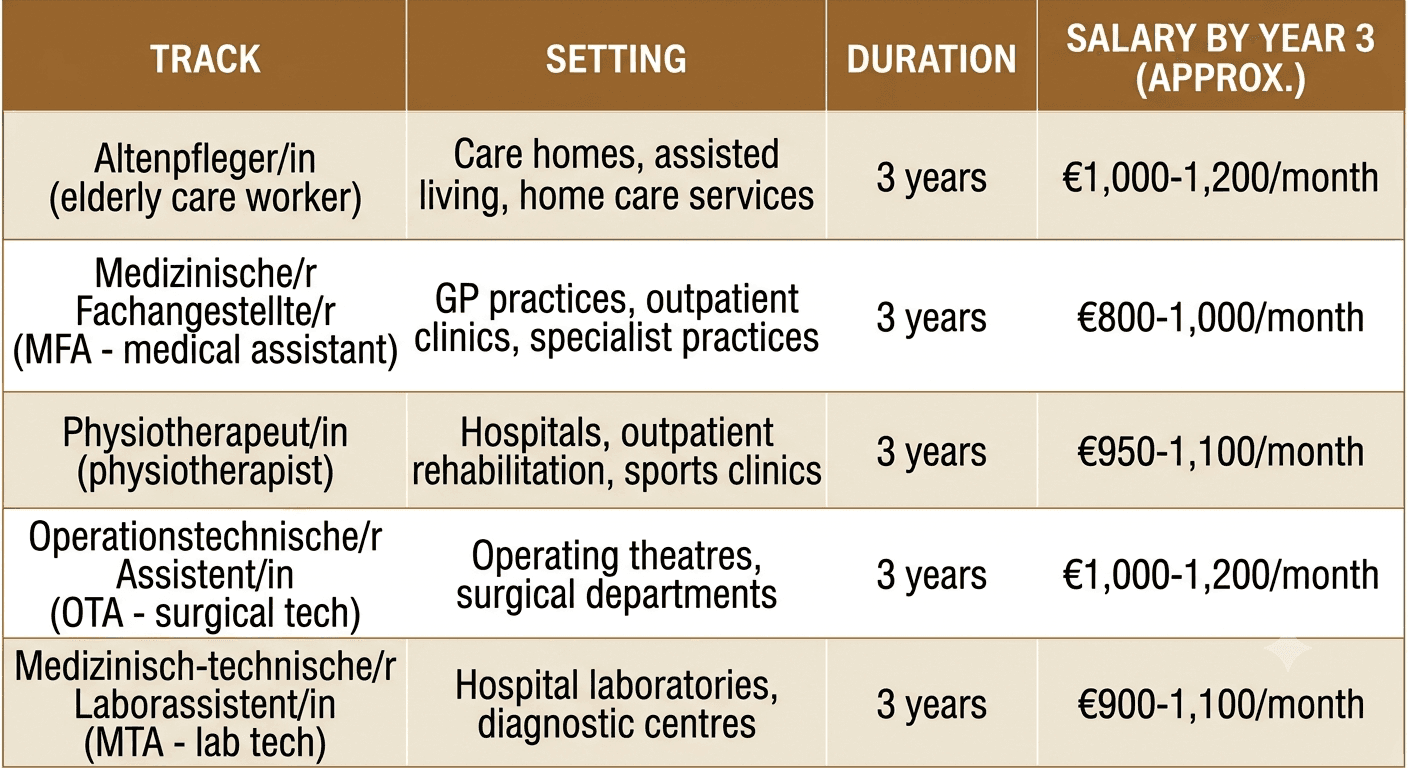
Germany offers five main healthcare Ausbildung tracks that are open to international candidates with the appropriate German language certificate. Each serves a different clinical or care setting.
Salary figures are approximate gross monthly stipends based on Bundesagentur fur Arbeit data (2024) and TVöD collective agreement rates. Figures shown are for year 3 of training. Year 1 salaries are typically 10-15% lower.
Altenpfleger/in: Elderly Care Ausbildung in Germany
Altenpflege has the highest vacancy rate of any healthcare Ausbildung track in Germany. The Bundesagentur fur Arbeit reported over 60,000 unfilled elderly care positions in 2023. This is the track where international recruitment is most aggressive and most structured. (Bundesagentur fur Arbeit, Engpassanalyse, 2023)
Trainees work in residential care homes, assisted living facilities, and home care services. The role covers personal care, medication administration, documentation, and coordinating with families and medical teams.
The German language requirement for Altenpflege is B2. Direct patient care in a residential setting demands confident spoken communication. Families ask questions. Residents share concerns. You need to handle both under time pressure.
Care home chains that actively recruit internationally include Korian, Alloheim, Orpea Deutschland, and AWO (Arbeiterwohlfahrt). These groups operate across multiple German states and have established procedures for processing international candidates.
Medizinische/r Fachangestellte/r: Medical Assistant Ausbildung
The MFA (Medizinische Fachangestellte) Ausbildung trains you to work in GP practices, specialist outpatient clinics, and health centres. The role covers patient reception, appointment management, basic clinical procedures (blood draws, ECG, dressing changes), and insurance documentation.
This track has a shorter patient interaction intensity than nursing or care work. Communication with patients is still frequent, but the setting is less emotionally demanding than inpatient care.
The language requirement starts at B1 for non-patient-facing administrative tasks within MFA training, but most employers expect B2 before hiring. GP practices in particular are small teams where communication gaps create real operational problems.
MFA positions are listed on the Bundesagentur fur Arbeit job portal at arbeitsagentur.de and the KBV (Kassenarztliche Bundesvereinigung) job board. The AOK health insurance job board also lists MFA Ausbildung positions from affiliated practices.
Physiotherapeut/in: Physiotherapy Ausbildung in Germany
Physiotherapy Ausbildung in Germany is technically classified as a school-based training programme (Berufsfachschule) rather than a dual system Ausbildung at some institutions. The key distinction: at many employers, especially hospital-affiliated therapy departments, you receive a paid training contract from the outset.
The programme covers therapeutic techniques, anatomy, kinesiology, patient handling, and rehabilitation planning. Trainees rotate through hospital wards, orthopaedic clinics, neurological rehabilitation units, and sports medicine departments.
Sri Lankan candidates with a background in sports science, biology, or pre-medical studies are well positioned for this track. The clinical knowledge base from Sri Lankan undergraduate programmes is relevant to the German curriculum.
Language requirement: B2 is expected for all patient-facing physiotherapy roles. Treatment sessions in Germany involve explaining procedures, assessing pain levels, and coaching exercises. All of this happens in German.
Operationstechnische/r Assistent/in: Surgical Tech Ausbildung
OTA (Operationstechnische/r Assistent/in) is one of the most technically specialised healthcare Ausbildung tracks. You train to assist in surgical procedures: preparing operating theatres, managing sterile fields, handling instruments, and supporting surgical teams.
The setting is a hospital operating theatre. The work is precise, protocol-driven, and high-stakes. Employers recruiting for OTA positions look for candidates with attention to detail, composure under pressure, and the ability to follow procedure without deviation.
OTA Ausbildung is offered primarily at university hospitals (Universitatsklinikum) and large district hospitals (Kreiskrankenhaus). DKG member hospitals (Deutsche Krankenhausgesellschaft) are the main source of OTA training positions. The DKG hospital database lists member institutions by state and can be used to identify which hospitals offer OTA training.
Language requirement: B2 minimum. Operating theatre communication is rapid, precise, and consequence-critical. B1 is not sufficient for this environment.
Medizinisch-technische/r Laborassistent/in: Lab Tech Ausbildung
MTA (Medizinisch-technische/r Laborassistent/in) Ausbildung trains you to work in hospital laboratories and diagnostic centres. You analyse blood samples, run microbiological tests, process histological specimens, and maintain lab equipment.
This is the least patient-facing of the five tracks. Direct patient contact is minimal. Most of your work involves samples, instruments, software, and documentation. This makes MTA the most accessible track for candidates who have a B1 language certificate and are still developing their conversational German.
The B1 language requirement applies specifically to the MTA track due to its limited direct patient interaction. However, written German competence is essential. Lab documentation, test protocols, and safety procedures are all in German.
Sri Lankan candidates with a background in biology, biochemistry, medical laboratory science, or chemistry are directly relevant to this track. Prior lab experience from Sri Lanka, even at university level, is a meaningful advantage in the application.
German Language Requirements for Healthcare Ausbildung
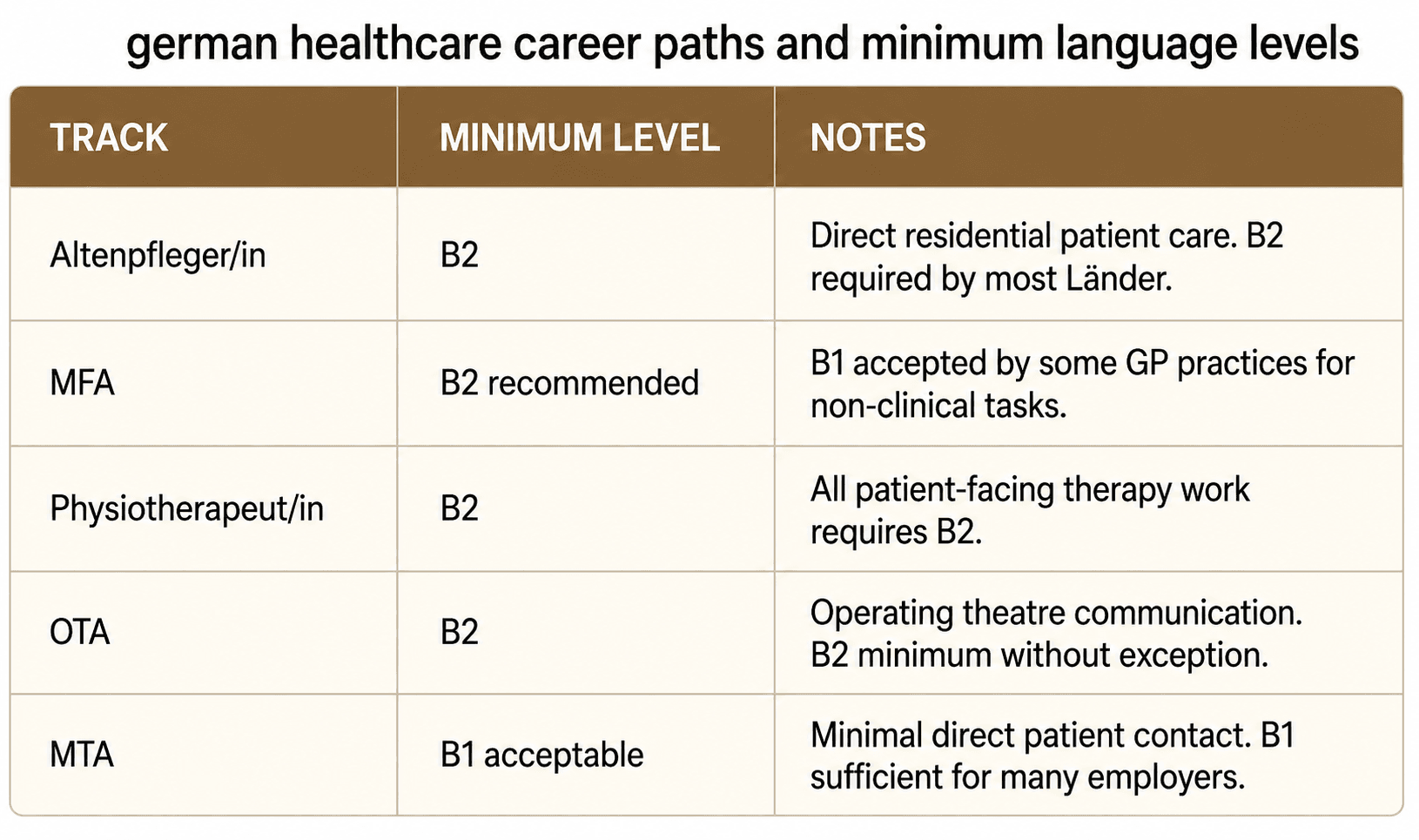
Language requirements in healthcare Ausbildung are not arbitrary. They are tied directly to patient safety and clinical communication. The requirements vary by the level of direct patient contact in each role.
Accepted certificates at the German Embassy Colombo include Goethe-Zertifikat, OSD, and telc Deutsch at the appropriate level. MALIROSA prepares Sri Lankan candidates for both the language exam and the healthcare-specific vocabulary that appears in the Berufsschule curriculum.
Where to Find Healthcare Ausbildung Employers in Germany
Healthcare Ausbildung positions are listed across multiple platforms. The most relevant for international candidates are below.
Bundesagentur fur Arbeit (arbeitsagentur.de/jobsuche): The official German federal employment agency job portal. Filter by "Ausbildung" and your target healthcare profession. This is the most comprehensive and authoritative source of registered training positions.
DKG member hospital portals: The Deutsche Krankenhausgesellschaft (DKG) represents over 1,900 German hospitals. Member hospital career pages are the primary source of OTA, MTA, and physiotherapy training positions. The DKG hospital finder at dkgev.de lists member institutions by state.
Care home chains with international recruitment: Korian (korian.de/karriere), Alloheim (alloheim.de/karriere), Orpea Deutschland (orpea-deutschland.de), and AWO (awo.org) operate across Germany and actively recruit non-EU candidates for Altenpflege Ausbildung positions.
AOK job board (aok.de/pk/uni/inhalt/stellenangebote): The AOK statutory health insurance job board lists MFA Ausbildung positions from affiliated GP and specialist practices across Germany.
Triple Win programme (Bundesagentur fur Arbeit): A formal international recruitment framework specifically for nursing and elderly care. It covers candidate screening, language training, visa processing, and integration support. Managed jointly by the Bundesagentur fur Arbeit and GIZ.
Why German Healthcare Employers Actively Recruit International Candidates
Germany passed the Fachkrafteinwanderungsgesetz (Skilled Immigration Act) in 2020 and expanded it significantly in 2023. The revised act explicitly simplifies Ausbildung visa processing for candidates from countries with bilateral skills agreements. Sri Lanka is within the eligible country group.
The demographic mathematics are straightforward. Germany has an ageing workforce in healthcare. The OECD projects that Germany will need to add 500,000 healthcare workers by 2030 to maintain current care standards. (OECD, Health at a Glance, 2023) Domestic training cannot close this gap.
Healthcare employers who have hired international trainees before know that motivated candidates from structured training backgrounds in Sri Lanka often outperform domestic trainees who entered the programme without a clear motivation. The commitment required to learn German, relocate, and complete a three-year programme signals sustained intent.
MALIROSA has placed Sri Lankan candidates with healthcare employers who specifically request international applicants. The pipeline from Sri Lanka to German healthcare is established, regulated, and growing.
Continue Your Journey
Full Ausbildung preparation from language to visa.
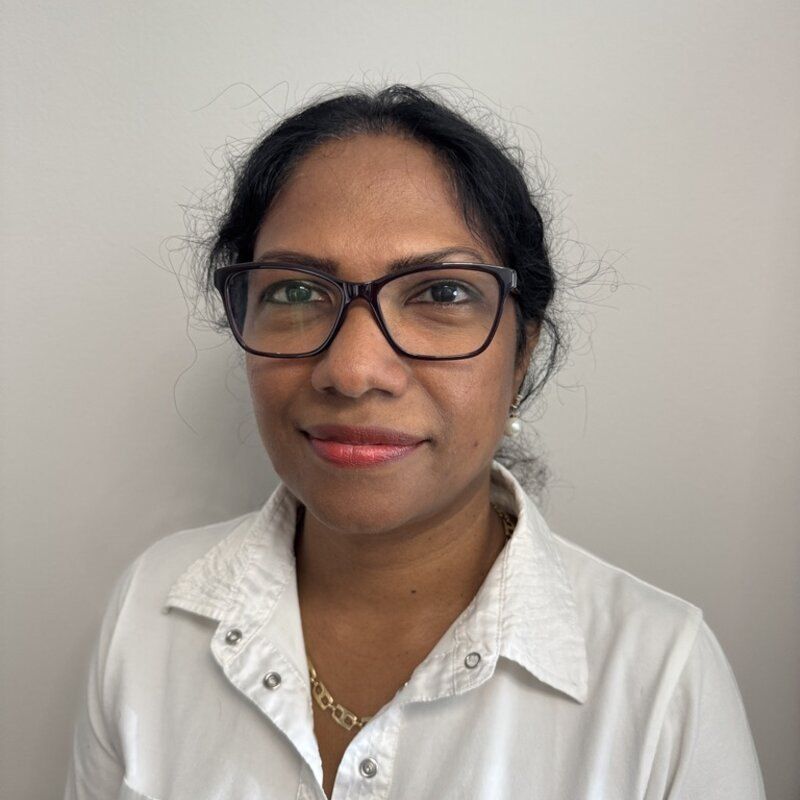
Randima Saiger is a co-founder of MALIROSA from Sri Lanka. She brings deep personal understanding of the Sri Lankan education system, family dynamics, and candidate aspirations, bridging local knowledge with Germany-side experience.
Healthcare Ausbildung in Germany is a state-regulated, employer-paid vocational training programme in a healthcare profession. It lasts three years and combines paid on-the-job training at a German hospital, clinic, or care facility with theoretical instruction at a vocational school (Berufsschule). The five main tracks open to international candidates are Altenpfleger/in (elderly care), MFA (medical assistant), Physiotherapeut/in (physiotherapy), OTA (surgical tech), and MTA (lab tech). There are no tuition fees. Trainees receive a monthly salary throughout the programme. (Source: Bundesagentur fur Arbeit, 2024)
Which healthcare Ausbildung has the highest salary in Germany?
Altenpfleger/in (elderly care worker) and OTA (surgical tech) both reach approximately €1,000-1,200 gross per month by year 3 of training, making them the highest-paying healthcare Ausbildung tracks. MTA (lab tech) and physiotherapy follow at €900-1,100/month by year 3. MFA (medical assistant) typically pays €800-1,000/month. Salary also varies by employer size and state: care home chains with collective agreements such as TVöD often pay at the upper end of these ranges. (Source: Bundesagentur fur Arbeit, 2024)
What German level do I need for healthcare Ausbildung?
The German language requirement for healthcare Ausbildung depends on the track. Altenpflege, physiotherapy, and OTA all require B2 because these roles involve direct patient care and clinical communication. MFA roles typically require B2 but some employers accept B1 for non-clinical tasks. MTA (lab tech) is the most accessible track with B1 accepted by many employers due to minimal direct patient contact. Accepted certificates include Goethe-Zertifikat, OSD, and telc Deutsch at the required level.
Can I do healthcare Ausbildung without a medical background?
Yes. Most healthcare Ausbildung tracks in Germany do not require a prior medical or healthcare qualification. The entry requirement is secondary school completion and the appropriate German language certificate. However, candidates with a relevant background in biology, nursing, laboratory science, sports science, or caregiving hold a meaningful advantage. Sri Lankan candidates should clearly present any relevant prior training or work experience in their application. Some employers offer aptitude assessments (Einstellungstest) during selection.
How long does healthcare Ausbildung take in Germany?
All five main healthcare Ausbildung tracks in Germany take three years to complete. During this time you split your schedule between the training employer (hospital, clinic, or care facility) and the Berufsschule (vocational school). At the end of the three years you sit a state examination to qualify in your profession. After passing, you hold a nationally recognised German healthcare qualification. Some employers offer permanent contracts to trainees before the programme ends.
MALIROSA places Sri Lankan candidates in verified German healthcare Ausbildung programmes.
Apply now to check your eligibility. We assess your German language certificate, review your background, match you with compatible healthcare employers, and support your full application through to visa approval at the German Embassy in Colombo.
Nursing Ausbildung in Germany: Salary, Requirements and How to Apply (2026)
Germany has 140,000+ unfilled nursing positions and is actively recruiting internationally. A nursing Ausbildung pays €1,000–1,300/month during training and leads to a qualified salary of €2,800–3,400 after completion. This guide covers the two nursing programmes, real salary figures, language requirements, Sri Lankan degree recognition, and how to find a hospital employer.
Ausbildung Salary in Germany 2026: What You Actually Earn by Sector
Germany pays you from your first day of Ausbildung training. The statutory minimum in 2026 is €682 per month in Year 1. In nursing and IT it is closer to €1,100. This guide breaks down real salary figures by sector, what taxes come out, and whether the numbers actually cover life in Germany.
8 min read
German Language
What German Language Level Do You Need for Ausbildung in Germany?
The German language requirement is the single biggest factor that determines whether a Sri Lankan candidate can pursue Ausbildung in Germany. Here is exactly what level you need, why it matters, and how long it takes to get there.
10 min read
Our Story
Two Worlds, One Purpose: The Story Behind MALIROSA
MALIROSA grew from a decade of living the exact journey that our candidates are about to begin: between Sri Lanka and Germany, between two cultures, two languages, and two very different sets of expectations.
5 min read
Visa & Pathways
Family Reunion Visa Germany: Who Can Apply, What Is Required, and How Long It Takes
Germany granted over 100,000 family reunion visas in 2023. Most applicants wait between three and twelve months for an appointment at the German Embassy. Understanding the requirements before you apply can cut that wait significantly.