Ausbildung Training Contract Germany: What to Check | Malirosa Pvt Ltd
Share
Ausbildung
8 min read
Ausbildung Training Contract (Ausbildungsvertrag): What to Check Before You Sign
Your German employer has sent you an Ausbildungsvertrag. Before you sign, know exactly what the contract must legally contain, what salary it should state, and which clauses are red flags. This guide covers BBiG requirements, your legal rights as a trainee, and how MALIROSA reviews contracts before you commit.
Your German employer has sent you a contract. It is in German. It is 4 to 6 pages long. And you need to decide whether to sign it.
The Ausbildungsvertrag is the legal foundation of your entire Ausbildung. It determines your salary, your working hours, your leave entitlement, and your rights if something goes wrong. Signing a contract with non-standard clauses or a below-minimum salary is a mistake that takes months to correct.
This guide covers every element the contract must legally contain under German law, the salary your contract should state by sector, the red flags that indicate a non-compliant employer, and your legal rights as a trainee once training begins.
Ausbildung Contract Germany Requirements: What BBiG Mandates
The Ausbildungsvertrag is required by law under Section 11 of the Berufsbildungsgesetz (BBiG), Germany's vocational training act. Every Ausbildung contract in Germany must contain the following elements. A contract that omits any of these is non-compliant.
Training occupation name: the exact German-language title of the profession you are training for, matching the official BBiG or relevant sector law designation.
Training duration: the total length of the training programme, typically 2 to 3 years depending on the occupation.
Daily working hours: the maximum daily hours expected during training. This must not exceed 8 hours per day under the Arbeitszeitgesetz (Working Hours Act).
Probationary period: the minimum probationary period is 1 month. The maximum is 4 months under Section 20 BBiG. Any contract stating a probation longer than 4 months is non-compliant.
Training salary (Ausbildungsvergu tung) per year: the salary must be stated separately for each year of training, as it increases each year. From 2024, the legally mandated minimum Ausbildung salary is set annually by the BIBB.
Annual leave entitlement: the minimum is 24 working days per year under the Bundesurlaubsgesetz. Trainees under 18 receive higher minimums under the Jugendarbeitsschutzgesetz.
Notice period: during the probationary period, either party can terminate without notice. After probation, the trainee can give 4 weeks notice with cause. The employer can only terminate for specified serious reasons.
Berufsschule attendance: the contract must confirm that the trainee is expected to attend the vocational school and that school days count as working time.
What Salary Should Your Ausbildung Contract State?
Germany introduced a statutory minimum Ausbildung salary (Mindestausbildungsvergu tung) in 2020 under Section 17 BBiG. For training contracts starting in 2026, the statutory minimum is €724 per month in year 1 (up from €682 in 2025), rising to €854 in year 2 and €977 in year 3. The first-year figure is indexed annually by the BIBB (Bundesinstitut fur Berufsbildung). (Source: BBiMindVergFBek 2026, BGBl. 2025 I Nr. 235)
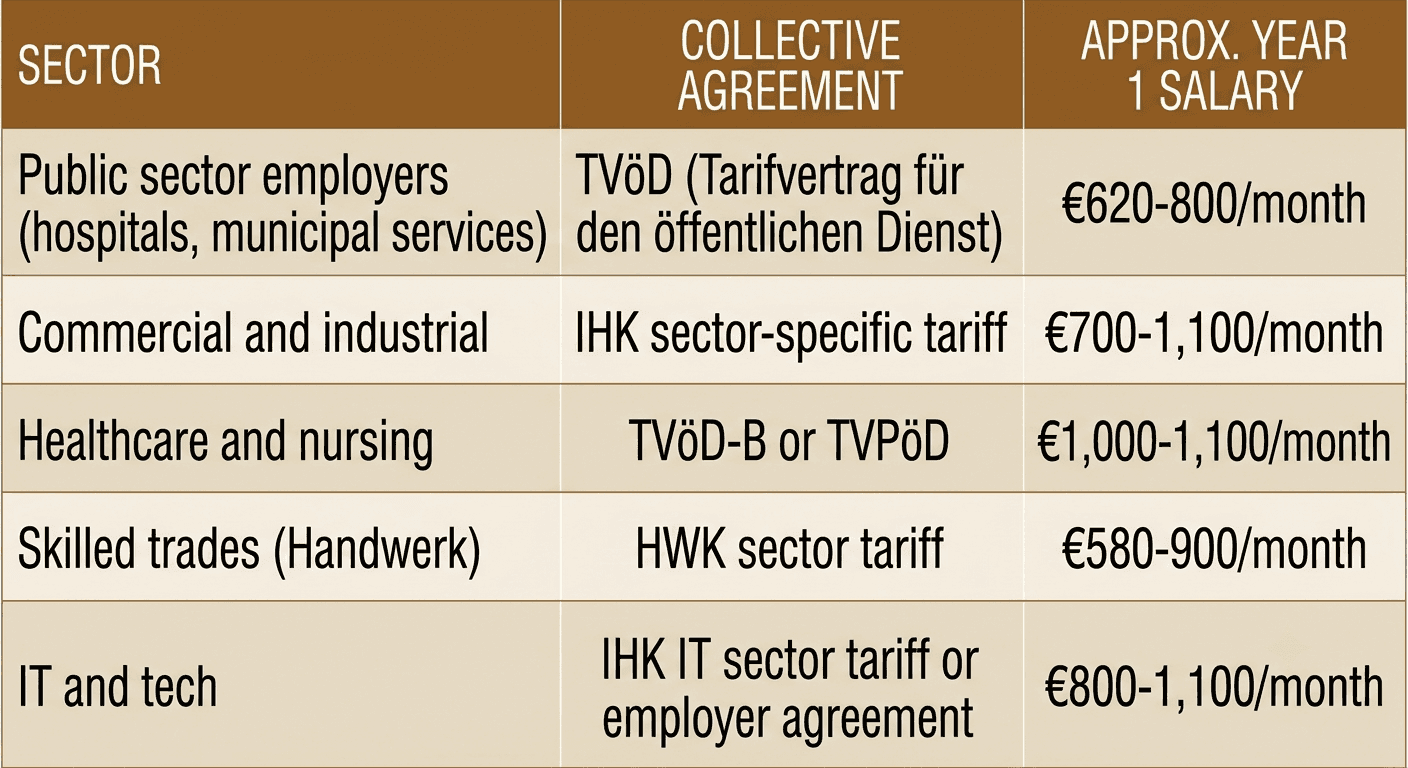
However, the statutory minimum is the legal floor, not the typical market rate. Most sectors operate under collective agreements (Tarifvertrage) that set significantly higher rates. Your contract should reference the relevant collective agreement for your sector.
To verify whether your contract salary matches the current sector collective agreement, use the Tarifregister at bmas.bund.de or ask MALIROSA to check the relevant Tarifvertrag before you sign.
What to Verify Before Signing
Beyond confirming that the mandatory elements are present, check the following before signing your contract.
Salary matches the current collective agreement for your sector. If the contract salary is below the Tarifvertrag minimum for your profession, this is non-compliant and negotiable.
Training location matches what was discussed. The contract must state the primary training location. If you discussed training in Munich but the contract lists Hamburg, clarify before signing.
Start date is confirmed in writing. The Ausbildung start date must appear in the contract. Verbal confirmation of a start date has no legal force.
Probation terms are within the legal 4-month maximum. A probationary period of 5 or 6 months is not legal under BBiG.
Berufsschule attendance rights are explicitly stated. You have a legal right to attend the vocational school and your employer cannot refuse this.
Annual leave entitlement meets or exceeds the 24-day minimum. Check the exact figure stated.
Red Flags in an Ausbildungsvertrag
These are the warning signs that indicate a non-compliant or potentially exploitative employer. Each one warrants a conversation with MALIROSA before you sign.
Salary stated below the statutory minimum or below the sector collective agreement rate. This is both illegal and a signal that the employer is not familiar with BBiG requirements.
No written contract offered before your start date. An employer who asks you to begin training without a signed contract is violating BBiG. Do not start without the signed document.
Pressure to sign immediately without time to review. German law does not require instant signature. A legitimate employer gives you time to read the contract.
Contract not in German. The original Ausbildungsvertrag must be in German by law. An English version may be provided alongside it, but the German original is the legally binding document.
Training company not registered with the relevant chamber. Employers offering Ausbildung must be registered with the IHK (Industrie- und Handelskammer) for commercial and industrial sectors, the HWK (Handwerkskammer) for skilled trades, or the relevant medical or care chamber for healthcare. Unregistered employers cannot legally offer Ausbildung.
Working hours exceeding 8 hours per day or 40 hours per week stated in the contract.
What Happens After You Sign the Ausbildungsvertrag
Once both parties have signed, the employer is legally required to submit the contract to the relevant chamber within a specified registration window. For commercial and industrial Ausbildung, this is the regional IHK. For skilled trades, the HWK. For healthcare, the relevant medical or care chamber.
The chamber registers the training contract and confirms that the employer is approved to offer training in your specific occupation. You will receive a signed copy of the registered contract. Keep the original. You will need it for your visa application and for any future disputes.
Your Ausbildungsvertrag is also a required document for your Ausbildung visa application at the German Embassy Colombo. The embassy verifies that the contract meets BBiG requirements and that the employer is chamber-registered.
Your Legal Rights as an Ausbildung Trainee Under BBiG
The BBiG gives you specific rights from the first day of your Ausbildung. These rights cannot be waived or removed by the contract.
Right to written training records (Berichtsheft or digitales Berichtsheft). Your employer must provide you with the format and must sign off on your records regularly.
Right to attend Berufsschule. School days are working time. Your employer cannot dock your salary or require you to make up school hours at the workplace.
Right to receive your agreed salary on time. Salary must be paid monthly, by the last day of each month at the latest.
Right to terminate during the probationary period without giving reasons. No notice period is required during probation.
Right to 4 weeks notice after probation if you need to leave due to serious reasons (Section 22 BBiG). You do not need to complete the full training period if the training conditions have materially deteriorated.
Right to receive a written assessment (Zeugnis) at the end of your training. This is your qualification documentation and your employer must provide it.
If you believe your employer is violating BBiG rights during training, the relevant chamber (IHK or HWK) runs a trainee advisory service (Beratung fur Auszubildende). You can contact the chamber directly. This is free and confidential.
How MALIROSA Reviews Your Ausbildung Contract Before You Sign
MALIROSA reviews Ausbildungsvertrag documents for Sri Lankan candidates before they sign. The review checks salary against the current sector Tarifvertrag, confirms the employer is chamber-registered, flags non-standard clauses, and confirms the probation and notice terms are within BBiG limits.
For candidates who have received a contract from an employer they found independently, this review takes 24 to 48 hours. We return a written summary of what is compliant, what needs clarification, and what should be negotiated before signing.
For candidates on the MALIROSA Ausbildung placement programme, this review is part of the standard placement process. We do not advise a candidate to sign a contract that does not meet BBiG minimums.
Continue Your Journey
Full Ausbildung preparation from language to visa.
Randima Saiger is a co-founder of MALIROSA from Sri Lanka. She brings deep personal understanding of the Sri Lankan education system, family dynamics, and candidate aspirations, bridging local knowledge with Germany-side experience.
What is an Ausbildungsvertrag (Ausbildung training contract)?
An Ausbildungsvertrag is a legally required written contract between a German trainee and their Ausbildung employer. It is mandated under Section 11 of the Berufsbildungsgesetz (BBiG). The contract defines the training occupation, training duration (typically 2-3 years), daily working hours, probationary period (max 4 months), training salary per year, annual leave entitlement (minimum 24 days), notice periods, and Berufsschule attendance rights. Without a signed Ausbildungsvertrag, training cannot legally begin and the employer cannot register the apprenticeship with the relevant chamber.
Is a training contract legally required for Ausbildung in Germany?
Yes. A written Ausbildungsvertrag is mandatory under Section 11 BBiG for every Ausbildung in Germany. The employer must provide the contract before the training start date. Once signed, the employer must register the contract with the relevant chamber (IHK for commercial and industrial sectors, HWK for skilled trades, medical chambers for healthcare). Starting training without a signed and registered contract is a violation of BBiG. Do not begin an Ausbildung without receiving and signing your contract first.
What salary should my Ausbildung training contract state?
Your Ausbildung contract must state the training salary (Ausbildungsvergutung) for each year of training. From 2025, the statutory minimum is €682/month in year 1, rising each subsequent year. However, most sectors operate under collective agreements (Tarifvertrage) that set higher rates. Public sector employers use TVoD. Healthcare uses TVoD-B. IT and commercial sectors use IHK sector tariffs. If your contract states a salary below the sector collective agreement minimum, this is non-compliant. MALIROSA can verify your contract salary against the current Tarifvertrag before you sign.
Can I leave an Ausbildung if the terms are not what was promised?
During the probationary period (maximum 4 months), you can terminate the Ausbildung at any time and for any reason without notice. After the probationary period, Section 22 BBiG allows you to give 4 weeks written notice if the training conditions have materially changed or the employer is not fulfilling their obligations. If the employer is violating BBiG terms, the relevant chamber (IHK, HWK, or medical chamber) has a trainee advisory service that provides free and confidential support. You are not legally required to complete an Ausbildung if the employer breaches the contract.
Does MALIROSA review Ausbildung contracts before signing?
Yes. MALIROSA reviews Ausbildungsvertrag documents for Sri Lankan candidates before they sign. The review checks the salary against the current sector Tarifvertrag, confirms the employer is chamber-registered, flags clauses that are non-standard or non-compliant with BBiG, and confirms probation and notice terms are within legal limits. For candidates who found an employer independently, the review takes 24 to 48 hours. For candidates on the MALIROSA Ausbildung placement programme, contract review is included in the standard process. Book a free consultation to discuss your contract.
Before you sign your Ausbildung training contract, have MALIROSA review it.
We check salary terms against the current sector collective agreement, confirm the employer is chamber-registered, and flag anything non-standard. Book a free consultation -- reviewing your contract before you sign costs nothing and protects your entire Ausbildung pathway.
Ausbildung Salary in Germany 2026: What You Actually Earn by Sector
Germany pays you from your first day of Ausbildung training. The statutory minimum in 2026 is €682 per month in Year 1. In nursing and IT it is closer to €1,100. This guide breaks down real salary figures by sector, what taxes come out, and whether the numbers actually cover life in Germany.
How to Find an Ausbildung Employer in Germany from Sri Lanka (2026 Guide)
You cannot show up in Germany and then find an Ausbildung employer. You need a signed training contract before your visa is approved. This guide covers every active portal, how to write applications German employers actually read, and the realistic timeline from first search to visa approval.
11 min read
Ausbildung
How to Apply for an Ausbildung Visa from Sri Lanka (2026 Step-by-Step Guide)
Most Sri Lankan Ausbildung visa applications are rejected not because candidates lack a training contract, but because their documents are incomplete or incorrectly certified. This step-by-step guide shows you exactly what the German Embassy in Colombo requires and how to avoid the errors that delay most applications by six months.
12 min read
Our Story
Two Worlds, One Purpose: The Story Behind MALIROSA
MALIROSA grew from a decade of living the exact journey that our candidates are about to begin: between Sri Lanka and Germany, between two cultures, two languages, and two very different sets of expectations.
5 min read
Visa & Pathways
Family Reunion Visa Germany: Who Can Apply, What Is Required, and How Long It Takes
Germany granted over 100,000 family reunion visas in 2023. Most applicants wait between three and twelve months for an appointment at the German Embassy. Understanding the requirements before you apply can cut that wait significantly.