IT Ausbildung Germany: Software, Networking & Tech Training | Malirosa Pvt Ltd
Share
Ausbildung
10 min read
IT Ausbildung in Germany: Software, Networking and System Integration Training
Germany has 137,000 unfilled IT positions and Fachinformatiker is one of the most recruited Ausbildung tracks in the country. IT Ausbildung pays €800–1,100/month during training. After completion, 74% of trainees receive permanent contracts. This guide covers the 4 specialisations, salary figures, language requirements, and how Sri Lankan STEM graduates approach this pathway.
Germany has 137,000 unfilled IT positions and no domestic pipeline to fill them. (Source: Bitkom e.V., Digital Economy Survey, 2023) German universities produce fewer than 30,000 IT graduates per year. The structural gap is not closing — it is widening. For Sri Lankan candidates with STEM training and developing German language skills, this is a legally supported entry point that did not exist five years ago.
Fachinformatiker is the most recognised IT Ausbildung track in Germany. It is an employer-paid, state-regulated training programme. You sign a contract, receive a monthly salary, and split your time between your employer and the vocational school (Berufsschule). No tuition fees. No unpaid internship.
This guide covers the four IT Ausbildung specialisations, exact salary figures, the German language requirement, where to find employers, and how Sri Lankan STEM candidates position their prior education for this pathway.
What Is an IT Ausbildung in Germany?
An IT Ausbildung is a dual vocational training programme regulated under the German Berufsbildungsgesetz (BBiG). You train as an employee, not as a student. A German company hires you as a trainee, pays your monthly salary, and provides on-the-job training in your specialisation.
In parallel, you attend the Berufsschule one to two days per week for theoretical instruction in programming, networking, project management, or digital business — depending on your track.
The standard duration is three years. Unlike university, there are no entrance exams and no tuition fees. The barrier to entry is your German language certificate and the employer's assessment of your aptitude and communication skills.
The 4 IT Ausbildung Specialisations in Germany
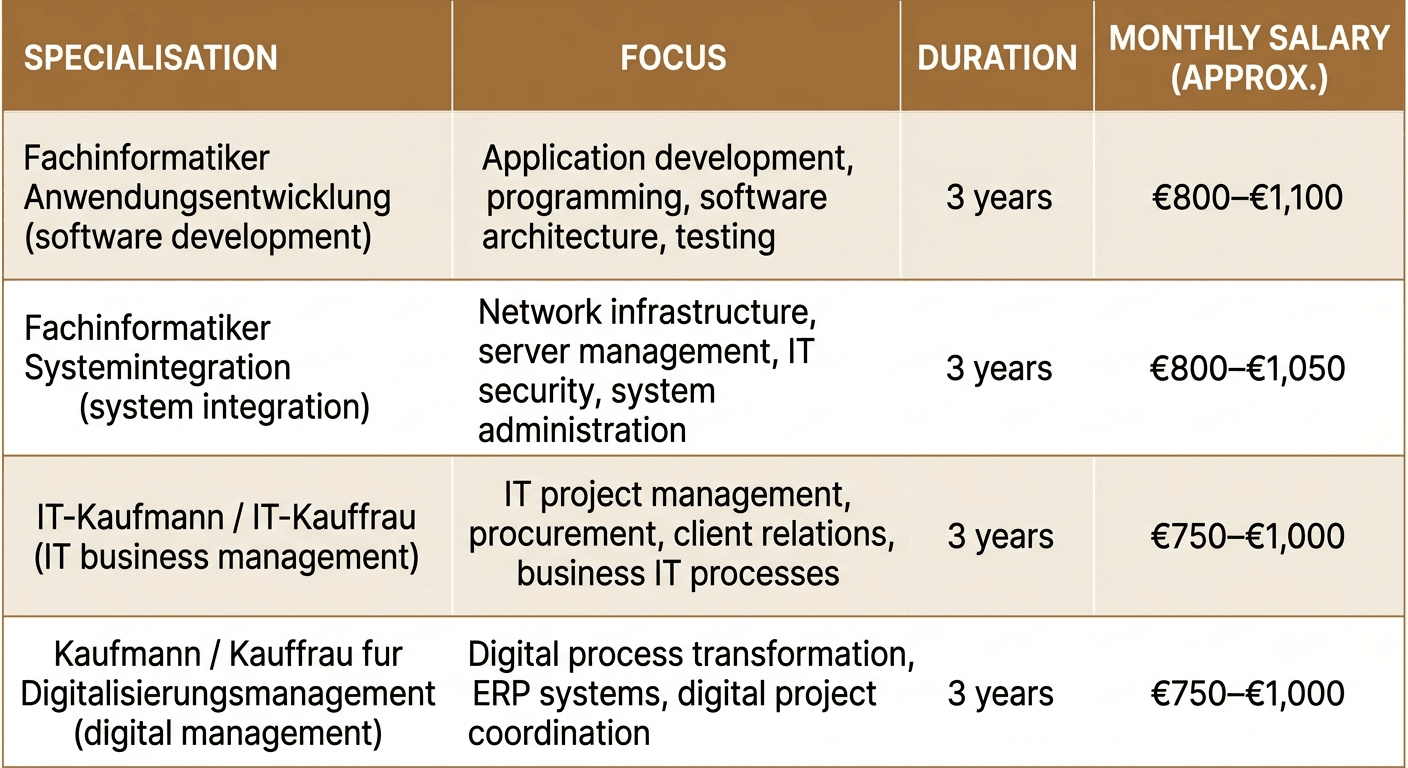
Germany offers four main IT Ausbildung tracks under the Fachinformatiker umbrella and related IT business qualifications. Each serves a different role in the industry.
Salary figures are approximate gross monthly stipends based on Bundesagentur fur Arbeit data (2024) and IHK employer surveys. Larger tech employers such as SAP, T-Systems, and Siemens typically pay at or above the upper end of these ranges.
Fachinformatiker Anwendungsentwicklung: The Software Development Track
This is the most in-demand IT Ausbildung track in Germany. You learn to design, build, and test software applications. The curriculum covers object-oriented programming, database design, software testing, and agile project methods.
Common programming languages taught include Java, Python, C#, and PHP, depending on the employer. Companies like SAP, Bosch, and mid-sized software houses offer this track across multiple German cities.
Sri Lankan candidates with prior programming experience, even self-taught, hold a meaningful advantage in this track. German employers in this space assess logical thinking and basic coding aptitude alongside German language ability. A portfolio of small projects strengthens your application.
Fachinformatiker Systemintegration: The Networking and Infrastructure Track
This track covers IT infrastructure: setting up and managing networks, servers, virtualisation environments, and IT security systems. It is the backbone of every IT department in Germany.
Graduates work as system administrators, IT support specialists, and network engineers. The Bundesagentur fur Arbeit reports this is one of the fastest-growing IT Ausbildung placements due to the expansion of cloud infrastructure across German industry. (Source: Bundesagentur für Arbeit, Berufe im Spiegel, Systemintegration, 2024)
Candidates with experience in networking, system administration, or IT support from Sri Lanka have directly transferable skills. Even informal experience with server setup or network configuration strengthens an application.
German Language Requirements for IT Ausbildung
The minimum German language level for IT Ausbildung is B1. Many employers, particularly in client-facing IT roles, prefer B2.
This requirement is practical, not arbitrary. German is the working language in most IT departments. Client communication, technical documentation, team meetings, and the Berufsschule curriculum all run in German. A candidate who struggles at B1 will find the three-year programme demanding.
MALIROSA recommends reaching B2 before applying to IT Ausbildung positions. B2 gives you access to employers at SAP, Siemens, T-Systems, and large IT consulting firms. These employers pay higher stipends, offer stronger training structures, and have established international candidate pipelines.
For the Berufsschule component, you need to read and write technical German fluently. IT terminology in German is partially anglicised (terms like Software, Server, Netzwerk carry over), which reduces the learning curve for English-speaking candidates.
How Sri Lankan Tech Graduates Qualify for IT Ausbildung
A German IT Ausbildung does not require a computer science degree. The entry requirement is secondary school completion (equivalent to Sri Lankan A/L or O/L depending on the employer and state) plus the German language certificate.
Sri Lankan candidates with a BSc in IT, Computer Science, or Engineering, or even partial university studies in STEM, are well positioned. German employers recognise that a candidate from a university STEM background brings analytical skills and programming exposure that goes beyond the Ausbildung baseline.
The key factor is how you communicate this in your Bewerbung (application letter) and interview. Your prior technical education is an asset. You do not need to downplay it. You frame it as background that makes you a faster learner in the training programme.
MALIROSA works with Sri Lankan IT and STEM candidates to structure applications that present prior education in the way German employers expect and respond to.
How to Find an IT Ausbildung Employer in Germany
Finding an IT Ausbildung employer requires direct outreach and an understanding of where these positions are listed. The process differs from university admission. You apply to a company, not an institution.
The main channels for finding IT Ausbildung positions are listed below.
ausbildung.de/informatik: The most comprehensive German Ausbildung portal. Filter by IT, location, and start date. Thousands of IT positions are listed year-round from employers across all German states.
IHK-Lehrstellenborse: The Chamber of Commerce (IHK) maintains a training position exchange. Each region's IHK lists local employers with open IT Ausbildung positions. Particularly useful for mid-sized companies not on major job boards.
LinkedIn Germany jobs: Search "Ausbildung Fachinformatiker" or "IT Ausbildung 2026". Large employers such as SAP, Siemens, T-Systems, and Bosch list IT Ausbildung positions here with English-accessible descriptions.
Direct company career portals: SAP (sap.com/careers), T-Systems (t-systems.com), Siemens (siemens.com/careers), and Bosch (bosch.com/careers) all maintain dedicated Ausbildung sections. These employers actively recruit IT trainees and offer above-average stipends and structured three-year programmes.
IT Ausbildung positions in Germany typically open for applications from September to March for training starts the following September. Larger employers such as SAP and T-Systems run structured intake rounds with fixed application windows. Smaller employers hire on a rolling basis.
What IT Ausbildung Employers Look For in Candidates
German IT Ausbildung employers assess candidates on four main factors: logical thinking, basic programming interest or aptitude, German communication skills, and reliability.
Unlike university admissions, grades are less important than demonstrated aptitude. An employer is investing three years in training you. They want evidence that you can learn, communicate, and work professionally in German.
For international candidates, a cover letter that is precise, error-free German and demonstrates knowledge of the employer's products or services makes a significant difference. Generic applications are screened out quickly.
Technical aptitude tests (Einstellungstest) are common at larger employers. These cover basic maths, logical reasoning, and sometimes simple programming tasks. Preparation for these tests is part of MALIROSA's Ausbildung placement support for IT candidates.
Career Outcomes After IT Ausbildung in Germany
IT Ausbildung has one of the strongest post-training retention rates in the German apprenticeship system. The BIBB (Bundesinstitut fur Berufsbildung) reported in 2023 that 74% of IT Ausbildung graduates receive a permanent employment contract from their training employer.
Starting salaries for qualified Fachinformatiker Anwendungsentwicklung range from €2,400 to €3,200 gross per month depending on employer size, city, and specialisation. (Source: Bundesagentur für Arbeit EntgeltatlaS, 2024) System integration graduates start in a similar range at €2,200 to €3,000 gross per month.
With three to five years of experience, IT salaries in Germany rise significantly. Senior software developers earn €4,000 to €6,000 gross per month. Senior system engineers and infrastructure specialists earn €3,500 to €5,000.
IT Ausbildung graduates are also eligible to pursue further qualifications. The Techniker or Meister certifications, or a part-time degree at a Fachhochschule, are common next steps for candidates who want to move into senior technical or management roles.
Continue Your Journey
Full Ausbildung preparation from language to visa.
Randima Saiger is a co-founder of MALIROSA from Sri Lanka. She brings deep personal understanding of the Sri Lankan education system, family dynamics, and candidate aspirations, bridging local knowledge with Germany-side experience.
IT Ausbildung in Germany is a state-regulated, employer-paid vocational training programme in information technology. It lasts three years and combines practical on-the-job training at a German company with theoretical instruction at a vocational school (Berufsschule). The four main tracks are Fachinformatiker Anwendungsentwicklung (software development), Fachinformatiker Systemintegration (networks and IT infrastructure), IT-Kaufmann/Kauffrau (IT business management), and Kaufmann/Kauffrau fur Digitalisierungsmanagement (digital management). There are no tuition fees. Trainees receive a monthly salary throughout the programme. (Source: BIBB, 2024)
What salary does an IT Ausbildung pay in Germany?
IT Ausbildung salaries in Germany range from approximately €750 to €1,100 gross per month depending on the specialisation and employer. Fachinformatiker Anwendungsentwicklung (software development) and Fachinformatiker Systemintegration (system integration) typically pay €800 to €1,100 per month. IT business management tracks pay €750 to €1,000 per month. Large employers such as SAP, Siemens, and T-Systems tend to pay at or above the upper end. After completing the Ausbildung, starting salaries range from €2,200 to €3,200 gross per month. (Source: Bundesagentur fur Arbeit, 2024)
Do I need a computer science degree for IT Ausbildung in Germany?
No. A computer science degree is not required for IT Ausbildung in Germany. The entry requirement is secondary school completion and a German language certificate at B1 or B2 level. However, Sri Lankan candidates with a BSc in IT, Computer Science, or Engineering bring significant advantages. Prior programming experience, analytical training, and STEM problem-solving skills are valued by German IT employers. These qualifications should be clearly communicated in the application letter rather than downplayed.
What German level is required for IT Ausbildung?
The minimum German language requirement for IT Ausbildung is B1. However, most employers for client-facing IT roles and those at larger tech companies prefer B2. The Berufsschule curriculum, technical documentation, team communication, and client interaction all run in German. MALIROSA recommends reaching B2 before applying to maximise your options and your chances of acceptance at higher-paying employers. Accepted certificates include Goethe-Zertifikat B2, OSD B2, and telc Deutsch B2.
How do I find an IT Ausbildung employer in Germany?
The main channels for finding IT Ausbildung positions in Germany are ausbildung.de/informatik (the largest Ausbildung portal), the IHK-Lehrstellenborse (Chamber of Commerce training exchange), LinkedIn Germany jobs (search Ausbildung Fachinformatiker), and direct applications to company career portals at SAP, Siemens, T-Systems, and Bosch. IT Ausbildung positions typically open for applications from September to March for September training starts. Larger employers run structured intake rounds; smaller companies hire on a rolling basis.
MALIROSA's Ausbildung placement programme supports IT and tech-track candidates from Sri Lanka.
Submit your profile — we assess your German language certificate, review your technical background, match you with compatible IT Ausbildung employers (including SAP, mid-sized software houses, and system integration firms), and support your application through to visa approval at the German Embassy in Colombo.
What German Language Level Do You Need for Ausbildung in Germany?
The German language requirement is the single biggest factor that determines whether a Sri Lankan candidate can pursue Ausbildung in Germany. Here is exactly what level you need, why it matters, and how long it takes to get there.
How to Find an Ausbildung Employer in Germany from Sri Lanka (2026 Guide)
You cannot show up in Germany and then find an Ausbildung employer. You need a signed training contract before your visa is approved. This guide covers every active portal, how to write applications German employers actually read, and the realistic timeline from first search to visa approval.
11 min read
Our Story
Two Worlds, One Purpose: The Story Behind MALIROSA
MALIROSA grew from a decade of living the exact journey that our candidates are about to begin: between Sri Lanka and Germany, between two cultures, two languages, and two very different sets of expectations.
5 min read
Visa & Pathways
Family Reunion Visa Germany: Who Can Apply, What Is Required, and How Long It Takes
Germany granted over 100,000 family reunion visas in 2023. Most applicants wait between three and twelve months for an appointment at the German Embassy. Understanding the requirements before you apply can cut that wait significantly.
9 min read
German Language
How to Pass the German B2 Exam from Sri Lanka: Goethe B2 vs OSD B2 Compared
B2 is the gateway to university admission in Germany, most skilled worker visas, and healthcare and IT Ausbildung contracts. If you are preparing from Sri Lanka, this guide covers exactly what B2 requires, how the Goethe B2 and OSD B2 compare in Sri Lanka, exam fees, registration, and a realistic preparation timeline from B1 to pass.