Nursing Ausbildung Germany: Salary, Requirements & How to Apply | Malirosa Pvt Ltd
Share
Ausbildung
10 min read
Nursing Ausbildung in Germany: Salary, Requirements and How to Apply (2026)
Germany has 140,000+ unfilled nursing positions and is actively recruiting internationally. A nursing Ausbildung pays €1,000–1,300/month during training and leads to a qualified salary of €2,800–3,400 after completion. This guide covers the two nursing programmes, real salary figures, language requirements, Sri Lankan degree recognition, and how to find a hospital employer.
Germany has over 140,000 unfilled nursing positions right now. (Source: Bundesagentur für Arbeit, Engpassanalyse Pflege, 2023) The federal government has responded by opening legal pathways for internationally trained nurses and nursing trainees from outside the EU. For Sri Lankans who want a structured route into the German healthcare system, nursing Ausbildung is one of the most viable and well-paid entry points available.
A nursing Ausbildung pays between €1,000 and €1,300 per month during your training years under the TVöD collective bargaining agreement. (Source: Bundesagentur für Arbeit EntgeltatlaS, 2024) After you qualify, starting salaries run €2,800 to €3,400 gross per month. The training takes three years. You are employed and paid from your first day.
This guide covers the two nursing programmes, exact salary data, German language requirements, how Sri Lankan nursing qualifications are assessed in Germany, and the steps to find a hospital employer and apply.
What Is a Nursing Ausbildung in Germany?
A nursing Ausbildung is a state-regulated, employer-based training programme. You sign a training contract with a hospital, care home, or healthcare facility. They pay you a monthly stipend while you split your time between practical nursing work at the facility and theoretical study at a nursing school (Pflegeschule).
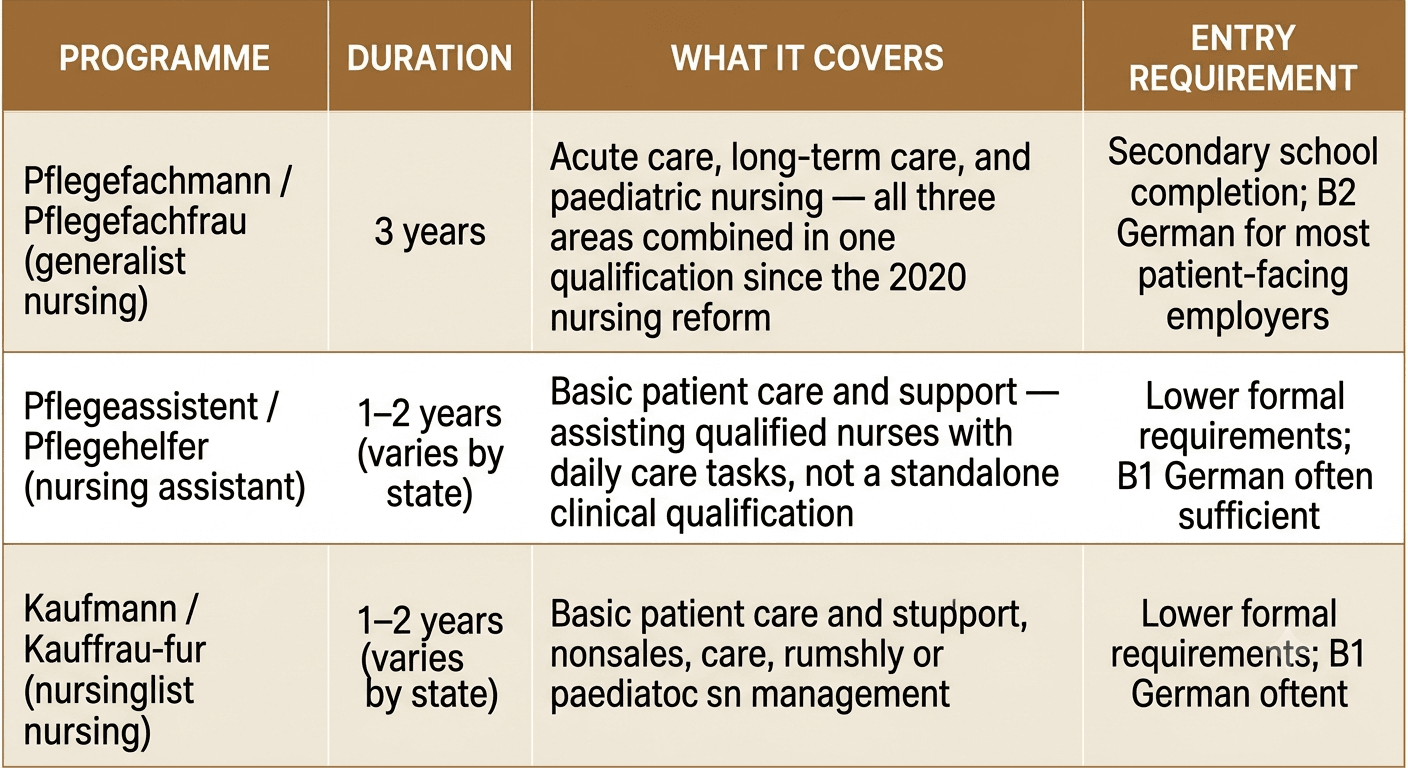
There are two main nursing programmes in Germany. Understanding the difference is important before you apply.
Since January 2020, the Pflegefachmann/Pflegefachfrau qualification replaced the previous separate qualifications in elder care, disability care, and acute nursing. The new unified programme qualifies you for all three care settings. (Source: Pflegeberufegesetz, Federal Ministry of Health, 2020)
Nursing Ausbildung Salary in Germany (2026)
Nursing is one of the highest-paying Ausbildung fields in Germany. The sector operates under TVöD (Tarifvertrag für den öffentlichen Dienst), the public sector collective bargaining agreement that covers most hospitals and care facilities. TVöD rates are published annually and consistently sit well above the BBiG statutory minimum.
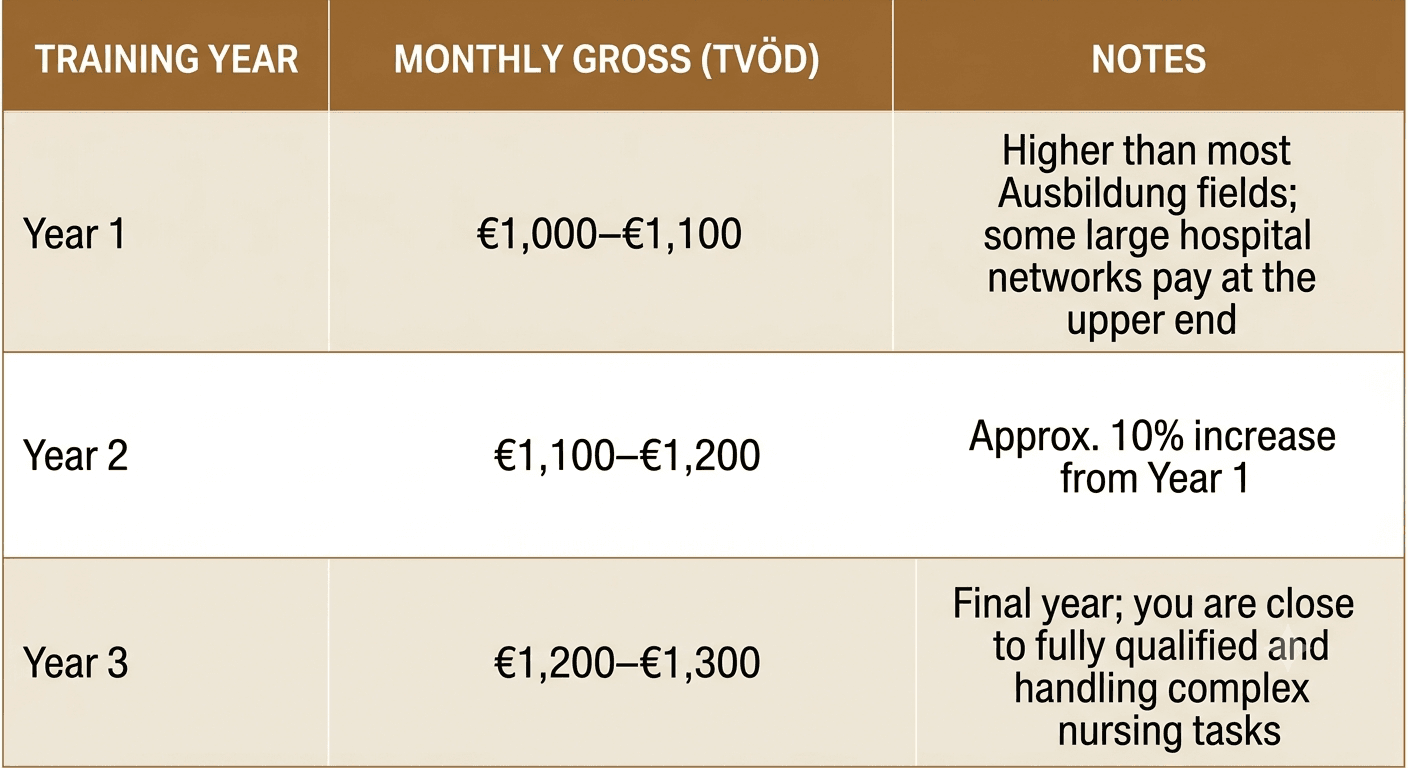
The figures below apply to the Pflegefachmann/Pflegefachfrau three-year programme under TVöD rates for 2025–2026. Private hospitals and care homes may offer slightly different rates, but most align closely with TVöD as a benchmark.
Source: Bundesagentur für Arbeit salary data (2024) and make-it-in-germany.com nursing sector overview. TVöD Anlage P rates apply to most public and non-profit hospital employers. Private employers typically pay within 5–10% of these figures.
What You Earn After Completing Nursing Ausbildung
Completing your Pflegefachmann/Pflegefachfrau qualification triggers a significant salary increase. You move from trainee stipend to qualified nurse pay under the full TVöD P-table rates.
A newly qualified nurse (Pflegefachkraft, P8 grade) earns approximately €2,800 to €3,400 gross per month in the first year of employment. (Source: Bundesagentur für Arbeit, EntgeltatlaS, 2024)
Night shift work, weekend work, and public holiday shifts carry additional pay supplements under German labour law. In healthcare settings, these supplements are common and meaningful. A nurse regularly working nights and weekends can add €300 to €600 per month to base salary.
With three to five years of experience and a specialisation (intensive care, anaesthetics, surgical nursing), gross monthly salaries of €3,500 to €4,200 are achievable. Senior nursing roles and nursing management positions sit above €4,500.
German Language Requirements for Nursing Ausbildung
The German language requirement for nursing Ausbildung is higher than for most other Ausbildung fields. This is not bureaucratic gatekeeping. Nursing requires precise communication with patients, families, and medical teams. Errors in documentation or verbal handover can have serious clinical consequences.
Most hospitals and care homes require a minimum of B2 German for patient-facing nursing roles. The Landesärztekammer (regional medical chamber) in some states requires B2 or higher for professional registration after training.
The officially required minimum under German healthcare regulations is B1 for nursing trainees, but practical reality is different. Most reputable employers in acute care will not accept candidates below B2. Care homes and nursing homes sometimes accept B1 with a clear plan to reach B2 within the first year.
For Sri Lankan candidates, MALIROSA typically recommends reaching B2 before applying to hospital employers. This gives you a materially stronger application and access to a wider range of employers, including larger hospital networks with better training infrastructure and higher TVöD pay rates.
Accepted language certificates include the Goethe-Zertifikat B2, OSD (Österreichisches Sprachdiplom) B2, and the telc Deutsch B2. All three are accepted by German healthcare employers and recognized for visa purposes.
Recognition of Sri Lankan Nursing Qualifications in Germany
If you already hold a nursing qualification from Sri Lanka, Germany has a formal pathway to assess whether it is equivalent to the Pflegefachmann/Pflegefachfrau standard.
The assessment is handled by state-level recognition authorities. In most German states, this is the Landesamt or regional Gesundheitsamt. The process typically takes three to six months.
There are three possible outcomes from the assessment.
Full recognition (Anerkennung): Your Sri Lankan qualification is deemed equivalent to the German standard. You can work as a Pflegefachkraft immediately after language requirements are met. This is uncommon for Sri Lankan nursing degrees without additional adaptation.
Partial recognition requiring an Anpassungslehrgang (adaptation course): You complete a structured top-up training programme, usually 6 to 18 months, that bridges specific gaps identified in the assessment. After completing the Anpassungslehrgang, you receive full recognition.
Partial recognition requiring a Kenntnisprüfung (knowledge examination): Instead of the adaptation course, you sit a theoretical and practical examination. Some candidates prefer this route as it is shorter if you study effectively.
The IQ-Netzwerk (Netzwerk Integration durch Qualifizierung) operates 24 regional advisory centres across Germany offering free counselling on qualification recognition. Their advisers can assess your Sri Lankan nursing documents before you begin the formal process. Website: netzwerk-iq.de
Using Anerkennungsberatung Before You Arrive in Germany
Germany offers an official recognition advisory service called Anerkennungsberatung. This is available to candidates who are still outside Germany and planning to move.
The service helps you understand how your existing qualifications will likely be assessed before you commit to the process. It does not make the final decision, but it gives you a realistic picture of whether your Sri Lankan nursing training aligns with German requirements and what additional steps you may need.
Access Anerkennungsberatung through the BAMF (Bundesamt für Migration und Flüchtlinge) online portal or through the Make It in Germany website (make-it-in-germany.com). The advisory sessions are free and available in multiple languages including English.
If you are applying through MALIROSA, our consultants will guide you through the Anerkennungsberatung process as part of the placement programme.
How to Find Hospital and Care Home Employers for Nursing Ausbildung
Finding the right employer is the most important step in the Ausbildung application process. Your employer pays your stipend, provides your practical training, and ultimately determines the quality of your experience in Germany.
There are three primary channels for finding nursing Ausbildung employers in Germany.
Bundesagentur für Arbeit job portal (arbeitsagentur.de): The official German employment agency lists Ausbildungsstellen (training places) across all sectors. Search for "Pflegefachmann Ausbildung" or "Gesundheits- und Krankenpfleger Ausbildung". Filter by region and start date.
Make It in Germany (make-it-in-germany.com): The federal government's official portal for international skilled workers. It includes a job board specifically for internationally trained healthcare professionals and nursing trainees.
Direct applications to hospital groups and care home networks: Large groups like Helios Kliniken, Asklepios, Vivantes, and Diakonie operate across multiple German cities and actively recruit international nursing trainees. Their career portals list open Ausbildung positions year-round.
Avoid third-party recruiters who charge Sri Lankan candidates placement fees. Legitimate German employers do not charge candidates for Ausbildung placement. MALIROSA does not charge placement fees to candidates; costs are covered by the employer partnership model.
How MALIROSA Supports Your Nursing Ausbildung Application
MALIROSA connects Sri Lankan candidates with verified German healthcare employers for nursing Ausbildung and care sector training positions. The support covers every stage of the process.
Language preparation: MALIROSA provides structured German language training from A1 through B2, including healthcare vocabulary preparation relevant to nursing environments.
Document translation and certification: We handle certified translation of your Sri Lankan nursing certificates, school leaving certificates, and supporting documents for the recognition authority process.
Employer matching: MALIROSA submits your profile to verified German hospital and care home partners actively seeking international nursing trainees. You are not applying blindly; you are being matched to employers who have agreed to sponsor international candidates.
Visa guidance: Once you have a training contract, MALIROSA guides you through the Ausbildung visa application process at the German Embassy in Colombo.
Continue Your Journey
Full Ausbildung preparation from language to visa.
Randima Saiger is a co-founder of MALIROSA from Sri Lanka. She brings deep personal understanding of the Sri Lankan education system, family dynamics, and candidate aspirations, bridging local knowledge with Germany-side experience.
What is the salary for a nursing Ausbildung in Germany?
Nursing Ausbildung in Germany pays €1,000 to €1,100 per month gross in Year 1, €1,100 to €1,200 in Year 2, and €1,200 to €1,300 in Year 3, under the TVöD public sector collective bargaining agreement. These figures apply to the Pflegefachmann/Pflegefachfrau three-year programme at most hospitals and non-profit care facilities. Private employers typically pay within 5–10% of these rates. After completing the Ausbildung, qualified nurses earn €2,800 to €3,400 gross per month as a starting salary. (Source: Bundesagentur für Arbeit, 2024)
What German level do you need for nursing Ausbildung?
The formal minimum is B1, but most German hospitals and care homes that hire international nursing trainees require B2 German for patient-facing roles. B2 is strongly recommended because nursing requires precise verbal communication with patients, families, and medical staff, plus accurate clinical documentation. Some care homes accept B1 with a commitment to reach B2 within the first year of training. MALIROSA recommends reaching B2 before applying to maximise employer options and application success rates.
Can Sri Lankans apply for nursing Ausbildung in Germany?
Yes. Sri Lankans can apply for nursing Ausbildung in Germany through an Ausbildung visa (§16a AufenthG). You need a signed training contract with a German employer, a minimum B1–B2 German certificate, and proof of secondary school completion. Germany has 140,000+ unfilled nursing positions and actively recruits internationally. Sri Lankan candidates with nursing backgrounds can also access the qualified professional recognition pathway if they hold an existing nursing qualification from Sri Lanka.
How long does a nursing Ausbildung take?
The standard Pflegefachmann/Pflegefachfrau nursing Ausbildung takes three years. It combines theoretical study at a nursing school (Pflegeschule) with practical training at your employer's facility. A shorter nursing assistant qualification (Pflegeassistent or Pflegehelfer) takes one to two years depending on the German state, but it does not qualify you as a registered nurse. After completing the three-year programme and passing final exams, you receive a state-recognised nursing qualification valid across all EU countries.
Is nursing Ausbildung in Germany free?
Yes. There are no tuition fees for nursing Ausbildung in Germany. Under the 2020 Pflegeberufegesetz reform, nursing school fees that previously existed in some states were abolished. Your employer pays your monthly training stipend (€1,000–€1,300 depending on year), and the Pflegeschule (nursing school) is funded through the state healthcare system. You are paid to train, not charged. This is one of the key advantages of the Ausbildung model over private nursing education.
MALIROSA's Ausbildung placement programme connects Sri Lankan candidates with verified German healthcare employers.
Submit your profile — we review your language certificate, assess your existing Sri Lankan nursing qualifications against German standards, match you with verified hospital partners who have confirmed international openings, and guide you from document preparation through to visa submission at the German Embassy in Colombo.
What German Language Level Do You Need for Ausbildung in Germany?
The German language requirement is the single biggest factor that determines whether a Sri Lankan candidate can pursue Ausbildung in Germany. Here is exactly what level you need, why it matters, and how long it takes to get there.
How to Apply for an Ausbildung Visa from Sri Lanka (2026 Step-by-Step Guide)
Most Sri Lankan Ausbildung visa applications are rejected not because candidates lack a training contract, but because their documents are incomplete or incorrectly certified. This step-by-step guide shows you exactly what the German Embassy in Colombo requires and how to avoid the errors that delay most applications by six months.
12 min read
Ausbildung
How to Find an Ausbildung Employer in Germany from Sri Lanka (2026 Guide)
You cannot show up in Germany and then find an Ausbildung employer. You need a signed training contract before your visa is approved. This guide covers every active portal, how to write applications German employers actually read, and the realistic timeline from first search to visa approval.
11 min read
Our Story
Two Worlds, One Purpose: The Story Behind MALIROSA
MALIROSA grew from a decade of living the exact journey that our candidates are about to begin: between Sri Lanka and Germany, between two cultures, two languages, and two very different sets of expectations.
5 min read
Visa & Pathways
Family Reunion Visa Germany: Who Can Apply, What Is Required, and How Long It Takes
Germany granted over 100,000 family reunion visas in 2023. Most applicants wait between three and twelve months for an appointment at the German Embassy. Understanding the requirements before you apply can cut that wait significantly.